
African Migration to the GCC (with Haggai Matsiko)
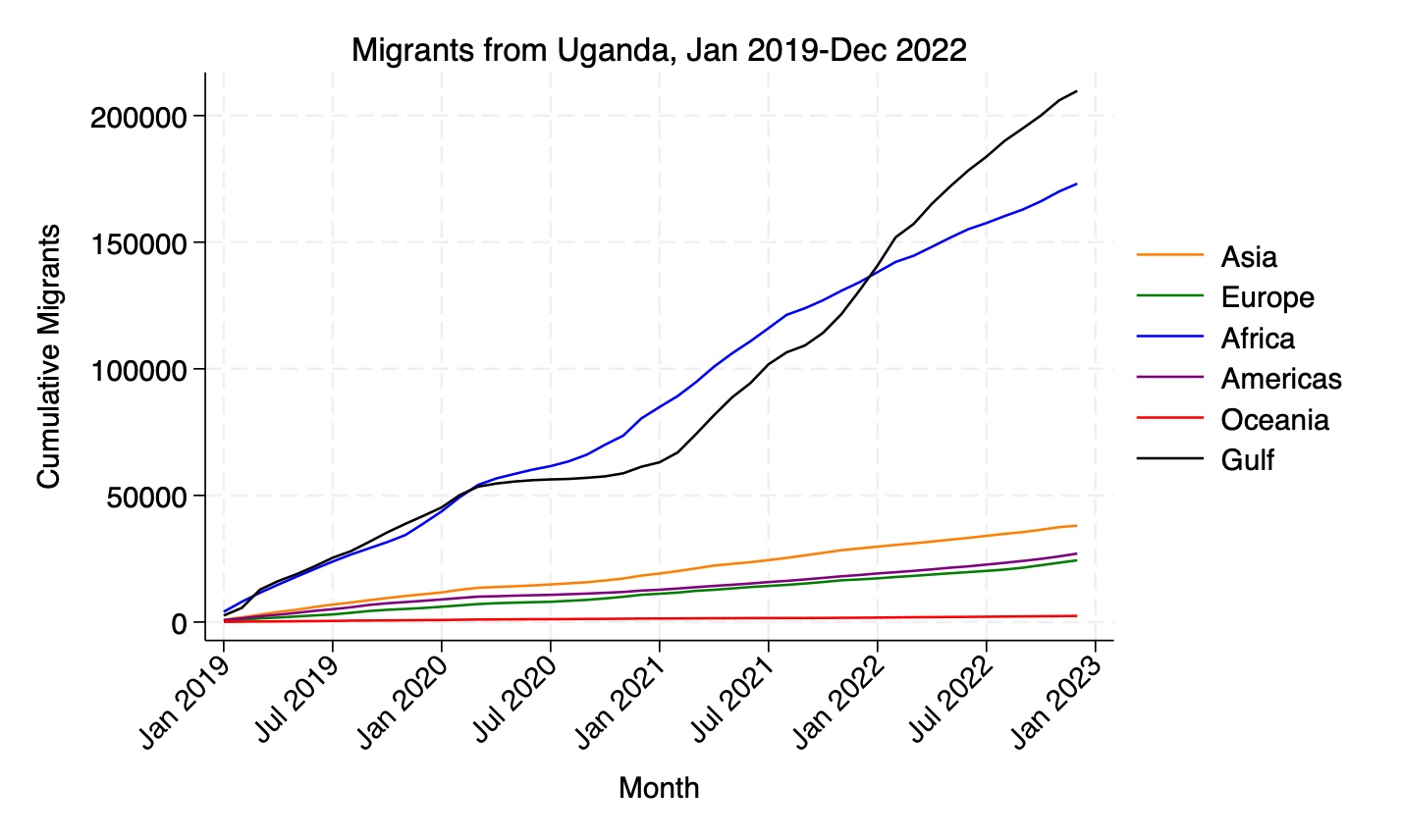
African migration to Gulf Cooperation Council (GCC) countries has increased dramatically in the past decade, particularly from East Africa. Despite the large and growing importance of migration to the Gulf, and some coverage in media and non-governmental reports, there has been very little scholarship investigating the diversity of experiences of migrant workers to the Gulf as well as the economic and political consequences of this migration. Unlike previous waves of migration, this new form is necessarily temporary, as there is no path to citizenship for migrants to the GCC. The vast majority of Africans who have traveled for work to the GCC will ultimately return home in the coming years. How will their experiences, socially, politically, and economically, affect them and their communities when they return home? Using a combination of interviews and surveys in both the UAE and Uganda, we examine how migration shapes migrants’ beliefs and aspirations, as well as the economic and political impact of mass migration and remittances in source countries.
Can fiction make the climate crisis real? An experiment in five countries
(with Andy Harris and Agabek Kabdullin)
This study examines the efficacy of narrative fiction on climate concern, emotions, climate justice position, and climate policy positions in the US, Spain, Germany, Nigeria, and India. Using an online survey of 10,000 respondents, we compare the effect of a fictional narrative about the potential consequences of climate change with a factual treatment, which is an edited version of a real news article covering a scientific article about climate change. We find that compared to the control condition, both fact and fiction treatments affected emotional reactions to climate change and increased respondents’ perception of the risk of a severe and fatal heat event in their own country. As expected, the treatments had little effect on policy preferences or behavioral intent to address climate issues. We also find that respondents reacted more strongly to versions of the fictional treatment in which the poor were disproportionately affected by the heat event.

Air Pollution Awareness in Africa
(with Andy Harris and Blair Welsh)
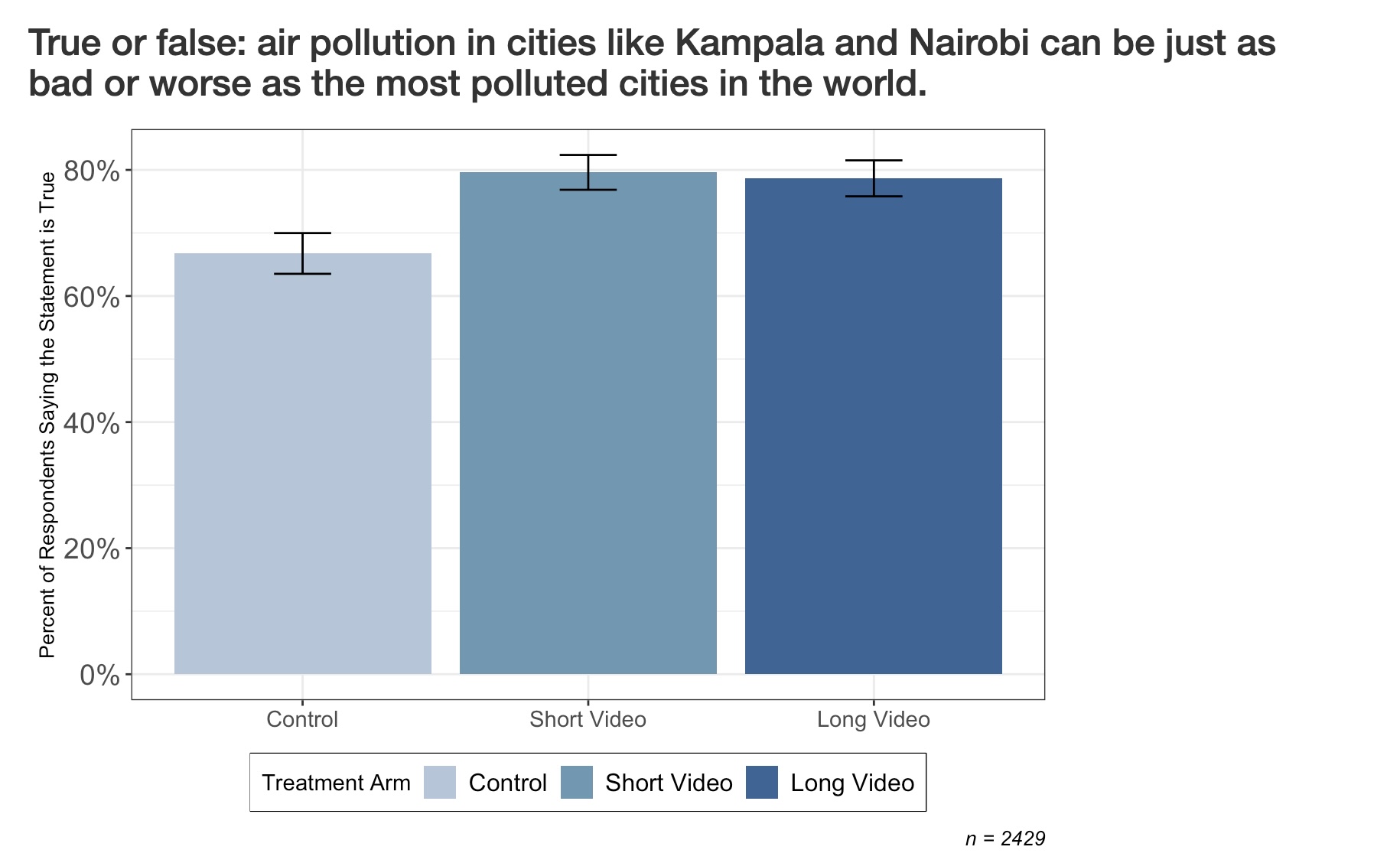
Air pollution has been increasing in cities across the developing world, and is particularly acute in urban centers of Africa and Asia. It contributes to as many as 7 million deaths annually, though public awareness about the causes and consequences of this health risk are quite low. In a first study, we conduct an online panel survey with over 4000 Ugandan respondents to measure awareness, knowledge, behavior, and policy preferences about air quality before and after the incorporation of air quality reporting into a major news broadcaster, Next Media. In a second study, we conduct representative in-person surveys in Kampala to assess baseline levels of air quality awareness and knowledge, and examine the effect of a short informational video on levels of concern, prioritization of air pollution, policy preferences, and behavior. We find that respondents underestimate the extent of pollution where they live, and 95% of Kampala residents have never heard of AQI. An information video served to increase levels of concern and knowledge in the short-term. About 40% of respondents were interested in messages regarding concerning air pollution to their local political representatives.
Limits on Learning: Selective Incorporation and Retention of Political Information
(with Andrew Little and Pia Raffler)
Does motivated reasoning limit the degree to which voters learn in response to political information, and the efficacy of interventions which aim to help them make informed decisions? A challenge for answering these questions is that motivated beliefs can be hard if not impossible to distinguish from rational beliefs. In this paper we develop a theory and diagnostic tool to detect motivated reasoning which does not focus on changes in beliefs but on whether new information is accepted or remembered in the first place. We then use this tool to reanalyze data from a set of experiments which found mixed effects of information treatments on voting behavior. Subjects who receive informational treatments are more likely to answer recall questions correctly when the information aligns with their preferences, which would appear to be a sign of motivated memory. However, we find similar patterns among the control group who received no information, which indicates the differences are likely driven by prior beliefs or guessing rather than selective memory. In sum, we find little evidence of motivated reasoning in this set of studies, and provide guidance for how to test for this phenomenon in other settings.
 Melina Raquel Platas