
"Commotion" prevents rape in Sierra Leone

This has been circulating around a bit, but I found it so outrageous/hilarious/absurd that I had to share here as well. Wronging Rights stumbled across a recent press release from Weyone, a “a public information outlet for the ruling All Peoples Congress political party” in Sierra Leone, in which the APC refutes allegations that women were raped by security forces last month at the headquarters of the opposition, the Sierra Leone People’s Party (SLPP).

The press release, titled, “We Meant No Harm to Womanhood and Reaffirm That Alleged Rape Is a Mere Fabrication” asserts, among other things, that the rape could not have occurred as it is alleged because:

“Under normal circumstance nature prevents the male penis from erecting when the individual is under threat or acting in a commotion. Even during war time incidents of rape occur when all is calm and quite and not when the battle in raging.
Thus, considering the circumstantial evidence, it is again very doubtful that the alleged victims indeed suffered from rape at a time when bottles and stones were being hurled from different directions…”

I’m sure this will be news to the hundreds of thousands of women who have been raped in wartime across the world.

For a far wittier evaluation of this incredible defense, see the original post on Wronging Rights, “In Which We Learn Something New About Penises.”
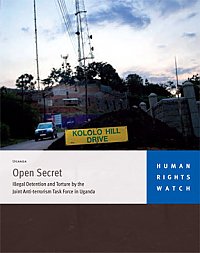
Torture in Uganda


Torture has been a sensitive subject for the government of Uganda, and has led to the arrest of journalists who cover the topic. Human Rights Watch today released their 89-page report, “Open Secret: Illegal Detention and Torture by the Joint Anti-Terrorism Task Force in Uganda.”

An article highlighting information related to the killing of four suspects can be found here.

A summary of the report, published in the Daily Monitor, is below:

JATT is torturing suspects – report

The Human Rights Watch will today release a report in which the Joint Anti-Terrorism Task Force (JATT), an arm of the Chieftaincy of Military Intelligence, is expected to be accused of wide-scale use of torture and illegal detention of suspects. The report is expected to put the government’s rights record in the spotlight.

Conducted between August 2008 and February 2009, the report lies on testimonies from former detainees.
This won’t be the first time the rights body takes issue with the government on abuse of human rights and freedoms.

Past reports have accused the government of torture, questioned transparency of security agencies and general transgression on the rule of law.

The last human rights report condemned the 2006 election violence, intimidation of the Opposition and raised concerns of fairness ahead of the 2011 elections.

When the beater is beaten, who wins?

This morning in Mulago hospital, a young man lay on a stretcher in the emergency ward, the side of his head split open over a lump that had swelled to the size of an apple. “Mob justice,” explained a nurse. “They were found beating a woman, and so they were beaten.” In the hall outside the room, two police officers waited for their suspects to be released. In the next room, patients waited to see the triage nurse, to register, to be whisked away to the appropriate ward, some of which remained too full to admit new patients.

I hoped the young man would make it, but I couldn’t help thinking that he was taking doctors and nurses away from so many other patients who hadn’t landed in the emergency room for beating someone (if in fact the story was correct, which it sometimes is not in the case of mob justice). I am sure the police saved the young man and his accomplice from the certain death they would have encountered at the hands of the mob.

According to Uganda’s 2008 Annual Crime Report, released last month, the incidence of mob justice is on the rise. The statement read by Inspector General of Police Maj. Gen. Kale Kayihura, “Last year registered a 100% increase in cases of mob action leading to death, from 184 cases in 2007, to 368 cases in 2008. Of these instances, 232 suspects were lynched on suspicion of theft and 59 on suspicion of murder. Suspected robbers, burglars and witchdoctors were other categories of persons murdered through mob action.”

He continued, “I am putting the public on notice that no one shall be allowed to take the law into their own hands, whatever the provocation or perceived justification. I have given strict instruction to the CID to apprehend and have all persons involved in mob action charged with murder.”

I am not sure what the apparent increase in prevalence of mob justice indicates. The obvious explanation for mob justice is that people feel that the legal justice system does not work for them and therefore must take matters into their own hands. But why more so now than before?

Want a Condom? Think again in the land of ABC

Uganda has long been hailed for its success in fighting HIV/AIDS, bringing prevalence rates from a high of 20-30% (depending on estimates) to 6%, where it has remained for the past several years. The success was attributed, among other things, to the ABC campaign — abstinence, “be faithful” and condom use. Well, I’m not sure about either the abstinence or the being faithful bit (though a new effort is being pushed forward with the be red campaign), but condom use remains tricky around here.

New Vision ran a fascinating piece in their Sunday edition, sending out reporters around the city/country asking to buy a condom from various shops. Results were mixed, but in general most were ridiculed, laughed at, or looked down upon for their purchase, where they were able to make it. It seemed to me the women fared worse…The men’s accounts are here and here, the women’s here, here and here.

This combined with the not uncommon idea that using a condom during sex is like eating candy with the wrapper on…

In any case, for those who thought promoting condom use abroad would be as (relatively) easy as it has been in the U.S. (where you often have 12 year olds putting condoms on bananas during sex ed class) should seriously think again, even in countries that have been supposedly successful in the fight against HIV/AIDS….

Rwanda Rising

Nobody likes to say “No, Mr. President.” So three years ago, when Costco CEO Jim Sinegal got a call from shareholder Dan Cooper, a partner in Chicago’s Fox River Financial Resources, asking if he’d have lunch with Rwandan president Paul Kagame, he agreed. That meeting in New York led to a presidential stop at Costco HQ near Seattle. Which led to Sinegal’s promise to visit Rwanda. “I made it in a moment of weakness,” he says, “before I realized how long it takes to get there.” He ended up taking his whole family, and today Costco is one of the two biggest buyers of Rwandan coffee beans — about 25% of the country’s premium crop, by Sinegal’s estimation. Without Cooper’s introduction, “no way would this have happened. I knew the Rwanda story, but I wasn’t intimately involved,” Sinegal says. “It took more elbow grease to get this started up, but it has been very profitable. Good for us and good for them.”

From the article in Fast Company magazine that CEO of Rwanda Development Board, Joe Ritchie, had mentioned in our interview last week in Kigali. Fortune magazine also addresses the issue of why CEOs love Rwanda.