What is the (global) village gossiping about?

What is the (global) village gossiping about?

Published online December 22, 2011.

Accessing people’s thoughts and interests from Asia to Africa is just a click away

It used to be that education primarily took place in a classroom. These days, the chalk and blackboard are fading away and steadily being replaced, or at least complemented, by new technology. Even in some of the world’s hardest-to-reach places, cell towers and solar-charging stations are re-inventing the learning and communication experience. Alongside the traditional classroom teacher are laptops and cell phones, paving the way toward a whole new way of seeing the world.

A world of data is at your fingertips, quite literally. The advent of personal computers and increasing interest in making information open and accessible to all means that we now have the ability to answer many questions faster and more accurately than we ever thought possible. Information on everything from economic growth to weather patterns to flu outbreaks is just a Google search away.  Data and data sources are not without their flaws, but we can often see broad patterns much more clearly across and within countries than we once could. The question is, how can we take advantage of new and ever increasing sources of information? Perhaps one of the most novel uses of data pieces together the wisdom of the crowd. In particular, Internet search terms are an amazing guide to all sorts of phenomena we care about, including public opinion on politics and policies, investment interests, and even trends in infectious disease.

What kind of information are people searching for? What are the questions to which they seek answers? One can of course look at broad trends in search engine search terms across countries, something similar to looking at words and topics that are “trending” on Twitter, but one can also look for more specific information. How many people in the U.S., Europe, or Asia look for information about Rwanda, for example? What kind of information do they look for? Google Insights for Search can help answer these kinds of questions, and reveal interests from potential investors, tourists, and others that can be useful to the local business community, government, civil society, and individuals.

If you look at the most frequent search terms related to “Rwanda” used by those living in the United States, France, or even China, you’ll find that most are related to the genocide or the movie, Hotel Rwanda. Within the U.S., searches for “Rwanda genocide” spike every April and May, although the spikes are becoming smaller over time. This is some indication that while the world still heavily associates Rwanda with genocide, this association is becoming weaker with time. Searches for “Rwanda safari” or “Rwanda gorillas” increased greatly in 2005 and 2007 respectively, and most of these searches came from individuals living in the United States or the UK.

Meanwhile, searches about Rwanda in the East African region show a very different pattern. The top three search terms about Rwanda from those living in Uganda and Kenya are all related to jobs, and primarily come from three cities, Kampala, Nairobi, and Mombasa. Meanwhile, searches from within Rwanda about Uganda focused on news outlets, such as the Daily Monitor, New Vision, and “news Uganda” more generally. The most common searches in Rwanda about Kenya include Kenya Airways, the Daily Nation, and Kenyan universities.

Understanding search trends can be useful for businesses and entrepreneurs, but they are also a cheap and easy way to do public opinion polling. In the U.S., search trends of the past couple of months have tended to mirror official polling trends for presidential candidates in the Republican party, for example. If you look over time, you can see the rollercoaster levels of support for candidates such as Rick Perry, Mitt Romney, Herman Cain, and Newt Gingrich. In the U.S., regular and nationally representative polls are conducted throughout the campaign period, but the more informal “search” polling can be very informative as well, and far less expensive.

One challenge for using this type of data in countries like Rwanda and Uganda is that relatively few people are online, although the number of internet users is growing by the day. In Rwanda, approximately 13 percent of people accessed the Internet in 2010, up from 7.7 percent in 2009, according to the International Telecommunication Union. More and more people are using their mobile phones, rather than computers, to access the Internet, which makes it easier to get online. Although there may not be enough people using Google to get a good measure of public opinion in Rwanda, this will very likely be possible in the not-too-distant future.

Already, one can observe trends in public interest in politicians among those living in capital cities. Searches for “Besigye”, Ugandan President Yoweri Museveni’s archrival, spiked within Kampala in November 2005, a few months prior to the heated 2006 presidential election, and spiked again to a lesser degree in February 2011, during the most recent election. It appears there was much more interest in Kizza Besigye leading up to the 2006 election (even with considerably fewer people online) than during the time leading up to the most recent elections, a trend which was reflected in Besigye’s support on election day as well. Online searches for Besigye spiked again in April, during the Walk-to-Work protests, but unfortunately for the repeat presidential candidate, by then the election had already passed. Despite the limited connectivity of the population living in Uganda, general election trends were evident in people’s online behavior.

Searches for "besigye" in Uganda, 2004-2011

Finally, search terms can be useful for tracking trends in infectious disease. When people fall sick, they often turn to the Internet for information about their symptoms or illness. Tracking search terms can thus identify and follow outbreaks of particular types of illnesses. Google Flu, for example, uses data on search terms to estimate trends in the spread of the flu virus. Again, their data is best for countries in which the majority of the population has access to the Internet, but as Internet connectivity increases in countries like Rwanda and Uganda, crowd-sourced data on infectious disease may help health officials identify and address outbreaks.

The wisdom of the crowd has for long eluded policymakers, investors, and even public health experts because it is costly to collect information from a large number of people, and people often have incentives to misrepresent their interests and beliefs. Using search trends, however, as one measure of people’s interests, opinions, and concerns, is one way to crowd-source information gathering in a relatively inexpensive and expedient manner.


Analyzing Africa: The Audacity of Despair

A new, defiant image

Published online at The Independent, Rwanda Edition, December 17, 2011

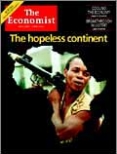
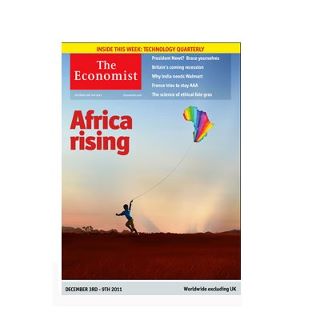
In 2000, the cover of The Economist pictured a boy wielding an AK47 inside the outline of the African continent, surrounded by black. “The hopeless continent,” the cover ominously read. At the time a combination of factors led the magazine and a whole host of bystanders to throw up their hands in despair, and mentally close the door to hope for the future of “Africa.” A decade later, The Economist, whose cover this week reads, “Africa rising” and many others, are waking up, wide-eyed, to realize the tremendous growth and progress that has been taking place on the continent all along. Progress has not been even, or without crushing reversals along the way. But given the history of development across the globe, it is entirely unclear why we should have anticipated linear progress, or lament its absence. Political, social, and economic development will carry on with or without handwringing at one extreme, or ululations at the other.

There have been at least two common mistakes in assessing progress (or the lack thereof) in “Africa,” which together have made for some rather wrongheaded analyses. First, there is a danger in conflating levels of development with development itself. It is obvious to all that levels of per capita income, education, and mortality, for example are lower on average in Africa than anywhere else. The issue of levels, however, is entirely different from change over time. Contrary to popular belief, improvement in both human and economic development was occurring in Africa before the dawn of the new millennium, just not everywhere. This leads me to the second analytic pitfall – the “Africa is a country” problem.

It is obvious to all that Africa is not a country but a continent, but analysis nonetheless often treats Africa as if it were one political, economic, or social unit. It is not. There is tremendous variation across the continent in both levels of development and rates of improvement over time. A failure to acknowledge the divergent paths countries have taken leads to the kind of essentialisation one tends to regret.

It is all too easy to essentialize. The mind recalls the most extreme cases, and remembers those that support prior beliefs. So in 2000, near the height of the HIV/AIDS epidemic, with flooding, drought, the Second Congo War, political crisis in Sierra Leone and a waffling UN Security Council, it was easy to create an image of Africa that was tearing itself to pieces. “Africa was weak before the Europeans touched its coasts. Nature is not kind to it,” wrote The Economist. “This may be the birthplace of mankind, but it is hardly surprising that humans sought other continents to live in.” Ouch.

As noted, it is true that levels of development, that is, income per capita, literacy, infant mortality, and many other measures of development, are comparatively far lower in sub-Saharan Africa, but all of this ignores the changes that have been taking place. In the 1990s, for instance, despite much pessimism, a number of countries held multi-party elections, a wave that started with Benin in 1991. While these countries would not become flourishing liberal democracies overnight, the 1990s would mark the beginning of the end of dictatorship as we know it.

There was also an effort to improve access to education, and the percentage of children completing primary school grew in a number of countries, including Benin, Burkina Faso, Cape Verde, The Gambia, Guinea, Guinea-Bissau, Liberia, Mali, Malawi, Togo, and Uganda, albeit occasionally starting at very low levels. Gains in education were not achieved everywhere, and schooling declined in some countries, but this fact only further demonstrates the variation in performance across African countries.

The best news is that although improvement in education varied, improvements in health over the past several decades have been nearly universal. Since 1960, child mortality has fallen in every single African country for which there is data, with the possible exception of Somalia. Even in a country like the Central African Republic (CAR), notorious for its poor governance, under-5 mortality fell by half over the past fifty years, from 300 to just over 150 deaths per 1000 births. In 1960, just over one in three children born in CAR would not live to see their fifth birthday; today six out of seven will survive childhood. Moreover, in spite of the devastating HIV/AIDS pandemic, which has claimed millions of lives, the hardest hit African countries are rebounding, and child and maternal mortality rates are again declining in countries like Botswana, Namibia, South Africa, and Zimbabwe.

Economically, the performance of African countries has been diverse for decades, with some countries consistently growing and others wallowing in economic misery. A number of African countries experienced periods of negative economic growth throughout the 1970s, 1980s, and into the 1990s, which, along with population growth throughout, meant that several had the same or even lower levels of per capita income in the 1990s than they had at independence.

Still, many countries began to see positive economic growth in the 1990s or earlier, including countries as diverse as Angola, Burkina Faso, Cameroon, Congo (Brazzaville), Ethiopia, Ghana, Guinea, Mali, Mozambique, Rwanda, Senegal, Uganda, and Zambia. Some of these economies are reliant on commodities such as oil and minerals, but service and other sectors comprise an increasing share of the economy in many countries, and regional trade has grown as well.

Average levels of development give Africa a bad name, but initial conditions were different from most of the rest of the world, and rates of improvement have often equaled or exceeded those in the developed world. As interest in Africa is piqued by double-digit economic growth figures and opportunities for investment, we will continue to see discussion of a part of the world most people inadvertently essentialize. Fortunately, I think the audacity of despair that has pervaded western thinking on Africa has left little in its wake other than egg on some faces. The audacity of hope has now come to the fore.

HIV in colonial Africa

Online this week in The Independent (Rwanda Edition): How public health efforts likely contributed to the early spread of HIV.

The Tragic Amplifier

Published online December 8, 2011.

This year marks the 90th anniversary, approximately, of the introduction of human immunodeficiency virus (HIV) into the human population. It also marks thirty years since HIV was first scientifically recognized in 1981. Since the 1920s, this virus has spread across the globe and become the HIV/AIDS pandemic we are all too familiar with today. Most people consider the 1980s to be the beginning of the HIV/AIDS pandemic, but the virus had been prevalent in populations living in parts of central Africa for decades before it became a global nightmare.

New evidence from epidemiologist and international health expert Jacques Pepin suggests that human efforts to improve public health in central Africa were critical in facilitating the early spread of HIV, which has since claimed nearly 30 million lives. In the past two decades, massive coordination, mobilization, innovation, and investment have managed to slow the epidemic and save millions. As we mark World AIDS Day on December 1, 2011, HIV/AIDS is a reminder to us all of the tremendous power of human folly, but also of human triumph.

The Origins of AIDS, by Pepin, is a remarkable new book that pieces together the emergence of HIV in the human population, and its subsequent spread across the globe. HIV is the human version of simian immunodeficiency virus (SIV), which has been present in chimpanzee populations of central Africa for hundreds of years. Human contact with chimpanzees led to at least one transmission of SIV to HIV in a human in the early 1920s, most likely a hunter or a cook living in central Africa, where the majority of SIV-carrying chimpanzees live. This transmission alone was extremely unlikely to have triggered an HIV epidemic, and indeed chimpanzee-to-human transmission could have occurred on separate occasions prior to the 1920s, but would not have spread far. An infected hunter may have passed HIV to his family members, but in all likelihood, the virus would have stopped there. Why did HIV begin to spread beyond a few infected individuals in the early 1920s?

Pepin argues that heterosexual transmission, which is the predominant mode of transmission of HIV today, could not alone have led to an outbreak of HIV on a scale that would trigger a pandemic. Thus, there must have been some kind of “amplifier” that allowed for very rapid transmission of HIV to many people at a time. And what was the mostly likely initial culprit in the amplification of the virus? Colonial public health campaigns involving widespread use of unsterilized syringes and needles.

In the 1930s and 1940s, colonial administrations in French Cameroon, the Belgian Congo, and elsewhere began massive public health campaigns to treat various infectious diseases, including yaws, syphilis, malaria, leprosy, and sleeping sickness, using syringes and needles which were not sterilized regularly, if at all (oral tablet versions of treatments were not available for these diseases at the time). Although there are no blood samples from this time period still in existence (the oldest blood sample in which HIV has been detected dates back to 1959, taken from a man living in Leopoldville, Congo, now known as Kinshasa), it is well documented that other less lethal viruses, like Hepatitis C, were transmitted via syringes in Cameroon, Gabon, and the Belgian Congo, among other colonies. It is not difficult to imagine that HIV could have been passed quickly through a population via syringe as well.

One clinic to treat sexually transmitted diseases (STDs) in Leopoldville treated up to 1000 patients a day by the mid-1950s, with documented evidence that medical equipment was not sterilized between patients. To make matters worse, HIV was likely introduced into Leopoldville/Kinshasa at a time when there was a dramatic gender imbalance due to colonial policies. Urban areas like Leopoldville were often the equivalent of “work camps” in which wives and children were not welcome, which resulted in widespread prostitution, further facilitating the spread of HIV through heterosexual transmission.

HIV, which first spread through non-sterile syringes, often in clinics aimed at treating sexually transmitted diseases among men and sex workers in urban areas, kept at a steady prevalence through heterosexual transmission among the same population. In the colonial period, female sex workers, or “free women”, had only a few regular clients each year, but by the time of independence, female prostitutes would often see up to 1000 clients per year. This new type of prostitution greatly facilitated the transmission of HIV to populations beyond urban areas, and spread along major trades routes and cities in central and eastern Africa, including Kigali.

By 1984-85, Kigali, which at the time had a high ratio of males to females, and thriving prostitution, had the highest recorded HIV prevalence in the world, with 80 percent of prostitutes, 50 percent of STD patients, and 15-20 percent of blood donors, factory workers, and hospital employees testing positive for HIV. By 1987, HIV prevalence was at 17.8 percent in urban areas and jumped to 27 percent in urban areas by 1996.

From central Africa, HIV soon spread to Haiti, before being transmitted via multiple routes to the United States and beyond. Today, 34 million people are living with HIV/AIDS, and another 29 million have perished. That the spread of this virus was likely facilitated, and perhaps only possible, with the help of human technology and early public health campaigns should give us pause, and remind us of the terrifying potential for destruction due to human folly. As Pepin writes, “When humans manipulate nature in a way that they do not fully understand, there is always a possibility that something unpredictable will occur.”

Turning the tide on the spread of HIV/AIDS has taken decades, and millions have tragically lost their lives in the process. But the HIV/AIDS epidemic also demonstrates the amazing power of human innovation and cooperation that can take place on a global scale. Today, there are 6.6 million people receiving life-saving antiretroviral treatment, and both AIDS-related deaths and new HIV infections are declining in most parts of the world. The time, research, energy and money that have gone into tackling HIV has been phenomenal. If anything, we are now in danger of devoting too few resources to other health challenges that must also vie for the attention of the global health community and domestic health budgets.

HIV/AIDS is an extraordinarily painful reminder of the good intentions that can pave the road to hell, and of the unique capability of humans to create as well as destroy.

HIV/AIDS: Human folly and triumph

Today is World AIDS Day. HIV has taken the lives of an estimated 29 million people around the world, and currently around 34 million people are infected. The effort of many individuals, organizations, and governments has led to a turnaround in the pandemic, infection rates and deaths due to AIDS are falling in most parts of the world. Still, there is a long way to go, and many people still do not have access to life-saving drugs.

A new book by Jacques Pepin, The Origins of AIDS, provides a remarkable account of how HIV initially spread among populations in central Africa, and later became the pandemic we know today. His sobering finding is that human efforts to treat and prevent disease with the use of non-sterilized syringes in colonial Africa very likely facilitated early and rapid HIV transmission. I discuss his work in this week’s column, excerpts of which is below.

HIV/AIDS: Human folly and triumph (published in this week’s Independent Rwanda Edition)

This year marks the 90th anniversary, approximately, of the introduction of human immunodeficiency virus (HIV) into the human population. It also marks thirty years since HIV was first scientifically recognized in 1981. Since the 1920s, this virus has spread across the globe and become the HIV/AIDS pandemic we are all too familiar with today. Most people consider the 1980s to be the beginning of the HIV/AIDS pandemic, but the virus had been prevalent in populations living in parts of central Africa for decades before it became a global nightmare.

New evidence from epidemiologist and international health expert Jacques Pepin suggests that human efforts to improve public health in central Africa were critical in facilitating the early spread of HIV, which has since claimed nearly 30 million lives. In the past two decades, massive coordination, mobilization, innovation, and investment have managed to slow the epidemic and save millions. As we mark World AIDS Day on December 1, 2011, HIV/AIDS is a reminder to us all of the tremendous power of human folly, but also of human triumph.

*                   *                   *

Turning the tide on the spread of HIV/AIDS has taken decades, and millions have tragically lost their lives in the process. But the HIV/AIDS epidemic also demonstrates the amazing power of human innovation and cooperation that can take place on a global scale. Today, there are 6.6 million people receiving life-saving antiretroviral treatment, and both AIDS-related deaths and new HIV infections are declining in most parts of the world. The time, research, energy and money that have gone into tackling HIV has been phenomenal. If anything, we are now in danger of devoting too few resources to other health challenges that must also vie for the attention of the global health community and domestic health budgets.

HIV/AIDS is an extraordinarily painful reminder of the good intentions that can pave the road to hell, and of the unique capability of humans to create as well as destroy.

Tackling Global Health: Women and Water

Below is my column, online this week, for the Rwanda Edition of the Independent magazine.

Tackling Global Health: Women and Water

Published online November 29, 2011

History suggests that women and water are essential in conquering the developing world’s health challenges

World Toilet Day came and went without much fanfare. In between using the toilet yourself, you probably missed it. Talking about toilets is not sexy, and discussing water and sanitation is probably not at the top of your list, but it should be. Women and water, specifically clean water, have been responsible for major improvements in health in the developed world and hold enormous potential for tackling its health challenges.

At the turn of the 20th century, some of the top killers in the United States included tuberculosis, pneumonia, typhoid, meningitis, influenza, and diarrhea (for children under two years of age).  In 1900, approximately one in six American babies would not live to see their first birthday, according to one recent estimate. In just thirty years, however, infant deaths in the U.S. had fallen by more than half, to an estimated 70 deaths per 1000, approximately equivalent to infant mortality rates in Rwanda today. What accounts for this tremendous improvement in child health in America?

It is tempting to suggest that new medical technologies led to massive improvements in health, and particularly child health. In the course of the 20th century we saw an unprecedented period of medical innovation, which ultimately led to the widespread availability of life-saving vaccines, antibiotics, and other medical technologies we take for granted today. But what is remarkable is that the decline in mortality, particularly due to infectious disease, occurred before the spread, and often before the invention, of these technologies.

Deaths due to scarlet fever had fallen to nearly zero by the time penicillin, a common antibiotic today, was invented in 1946. Similarly, deaths from typhoid and tuberculosis fell dramatically before the introduction of antibiotics to treat these bacterial infections were invented in 1948 and 1950, respectively. It was not until 1963 that a vaccine to prevent measles was invented, by which point very few people died of measles in the U.S. Most of the decline in mortality from infectious diseases in the U.S. occurred before the introduction of medical technology used to prevent or treat them.

So what accounts for the decline in mortality due to infectious disease? To a large extent, women and water. Recent research by Grant Miller of Stanford University finds that women’s suffrage in the U.S. directly contributed to increases in public health spending in the 1920s. Much of this health spending went toward public campaigns to improve hygiene. Around 20,000 child deaths were averted as better hygiene prevented the spread of deadly infectious diseases. Miller argues that legislators anticipated women support of public funding for health, and voted for more progressive public reforms as soon as they won the right to vote.

In related work, Miller and economist David Cutler find that improvements in water systems in the U.S. between 1900 and 1940, specifically filtration and chlorination, contributed to three quarters of the decline in infant mortality and two thirds of the decline in child mortality during this period. Waterborne diseases were responsible for a large proportion of deaths during this time, particularly in U.S. cities, and water treatment and filtration led to a major decline in these waterborne illnesses.

Today, over one billion people around the world do not have access to clean water, and over two billion to not have access to sanitation facilities. In Rwanda, only an estimated 23 percent of the population had access to adequate sanitation in 2006, and in Uganda only 33 percent. In Uganda’s capital city, Kampala, only eight percent of homes are connected to a sewage line. A greater proportion of the population have access to clean water—64 percent in Uganda and 65 percent in Rwanda—but nearly one third of the population continues to consume unsafe water on a daily basis.

Much of the emphasis on public health today focuses on supply-side factors – on health care rather than health, on curative rather than preventive treatments, on hospitals rather than homes. But history suggests that the greatest improvements in health have taken place within the home, with a focus on preventing infectious disease rather than treating it. Women play a key role in this process. Women are more likely to be in charge of feeding children and ensuring their homes have clean water and adequate sanitation, and some research suggests women tend to place greater value on child welfare (this is why cash transfers programs often target women in the household, rather than men). As we have seen in the U.S., women voters can have a profound impact on legislator behavior and consequently, public policy.

Survey evidence from the Afrobarometer suggests that health is a major concern for ordinary Ugandans, and populations throughout sub-Saharan Africa. In 2011, 26 percent of Ugandans said that “improving public services such as education and health” was their top concern, and 50 percent said that health was among the “most important problems facing this country that the forthcoming 2011 elections should address,” and ranked health higher than any of the thirty-odd other policy issues. Whether legislators act on the policy preferences of their constituents is another matter altogether. Nevertheless, the potential of the electorate, and women in particular, to influence public policy should be taken seriously, especially with regard to health.

A focus on hygiene may be as efficacious, if not more so, than the antibiotics and antimalarial drugs that are ubiquitous in public health today. The difference between 1920s America and the developing world in 2011 is that we are not forced today to rely on prevention of disease, because the momentous gains in medical technology allow us to treat the most common causes of death and disability. But this new technology should not become a crutch, and we should not forget the tremendous gains in population health that can be made by focusing on hygiene rather than a vaccine. Toilets may not be sexy, but life without adequate sanitation just stinks.

Beyond the State: Letters from Gulu

Apologies for the extremely sparse posting of late. I have just returned from a trip to Central America, including Belize, Honduras, and Mexico, which I’ll post more about soon. In the meantime, I’d like to share the first edition of a weekly column I began writing for the Independent (Rwanda edition) three weeks ago. I’ll be posting these weekly after they are published online. I look forward to your comments and feedback.

Beyond the state: letters from Gulu

Published online November 23, 2011

Health care, education, basic infrastructure, and security are some of the services the modern state seeks to provide. The success of states in delivering these goods to their far-flung populations, especially in the midst of conflict or under severe resource constraints, is quite variable. In recent years, for example, Rwanda has been lauded for implementing a health insurance scheme that covers all Rwandans and offers them a range of health services, while the reach of the state in countries like the Democratic Republic of Congo or South Sudan is much more limited. While there are important lessons to be learned from the success of the Rwandan state, which has proven itself unusually efficacious in a number of sectors, it is all too easy to overlook the ways in which information and innovation flow alongside the state, and often in spite of state failures. Tremendous opportunity lies beyond the state.

I recently unearthed letters given to me in mid-2005 by a group of primary school students in Gulu, northern Uganda’s largest city, illustrating this point. At the time, to cross Karuma Falls, where the Nile cuts the land like a scythe, was to enter a world far removed from political drama unfolding in Kampala. While Ugandan President Museveni was jostling for the removal of term limits in the capital, the terror of the Lord’s Resistance Army (LRA) in northern Uganda was still unfolding, though nearing its final days. The river dividing north from south might as well have been an ocean.

The reach and strength of the state was limited. Getting to Gulu from the capital carried its risks – tarmac fell away at the edges of the road much of the way from Kampala to Karuma, rebels lingered somewhere north of the Nile, and reaching the environs beyond Gulu was an even greater challenge. The state could not guarantee security, much less provide quality public services. Then Prime Minister, Apolo Nsibambi, in charge of public sector management, did not even set foot in the north until the mid 2000s, more than five years into his term.

When I first received the letters, I was struck by the violent images many of the children in Gulu could portray with a couple of pens and a piece of paper. Looking back, however, more striking than these images are what these youngsters wrote. “Too many children one after the other”, wrote a young boy named Geoffrey. “If a woman is not allowed to rest between children, her reproductive system can be harmfully affected, and her children will not be properly cared for”. Another, Solomon, carefully printed Ghanaian Nobel laureate Raphael Armattoe’s poem, “The Lonely Soul”, word for word. Others wrote about the effect of AIDS on their community, and a young boy named Kenneth drew a picture of “Cent 50”, the American rapper.

These letters illustrate not the failure of the Ugandan state in the north, which had evidently been unwilling or unable to stop the marauding LRA for nearly twenty years, but rather the porous nature of society, and the tremendous opportunities that lie outside the state. These students demonstrate not the dismal quality of Uganda’s educational system in an insecure region, but rather their ability to utilize the resources at their young fingertips. At ages seven to ten, they shared information about child spacing, antenatal care, infertility, the spread of infectious disease, poetry, and American pop culture. Through what channels did they initially access this information? Through school and formal state structures? Possibly, though these are likely to be only part of the story. How can we use these channels, whatever they may be, to further promote innovation and the spread of information?

Our approaches to improving public health and education have often focused on things we can touch and see – a health center, a new classroom, an operating table, a chalkboard – but ignored the social networks and flow of information that do not respect administrative boundaries and are not tied to specific politicians and policies. This bias is in part due to the fact that physical infrastructure is highly visible, and as such, plays an important role in politics. It is much harder to see the networks of common knowledge than it is to see the building of walls. It is easy to undervalue and difficult to use that which we cannot see, at least politically. We tend to privilege infrastructure over information.

How do we take advantage of the vibrant flow of information today? How can we better understand the channels through which it flows – through communities, families, churches, mosques, media, and even music? The state is not the only, or even primary, conduit of knowledge with the potential to improve health, for example. The formal structures of the state and public service provision often seem to fail us – absenteeism among civil servants, rampant corruption, poor policy implementation – but the social structures that connect society have the potential to fill in the gaps.

What is remarkable is not how far we have to go in ensuring a minimum standard of living, which can seem like a daunting journey, but how far we have come, even in the midst of conflict and severe resource constraints. The state can and should play an important and perhaps guiding role in providing public services, but we should also try to understand and take advantage of the opportunities to improve health, education, and other social services already at our fingertips.

Childhood vaccination in sub-Saharan Africa

First of all, if you are in Kampala and interested in health, don’t miss the health journalism conference hosted by the Health Journalists Network in Uganda taking place today at Hotel Africana. Follow HEJNU on twitter for live updates here.

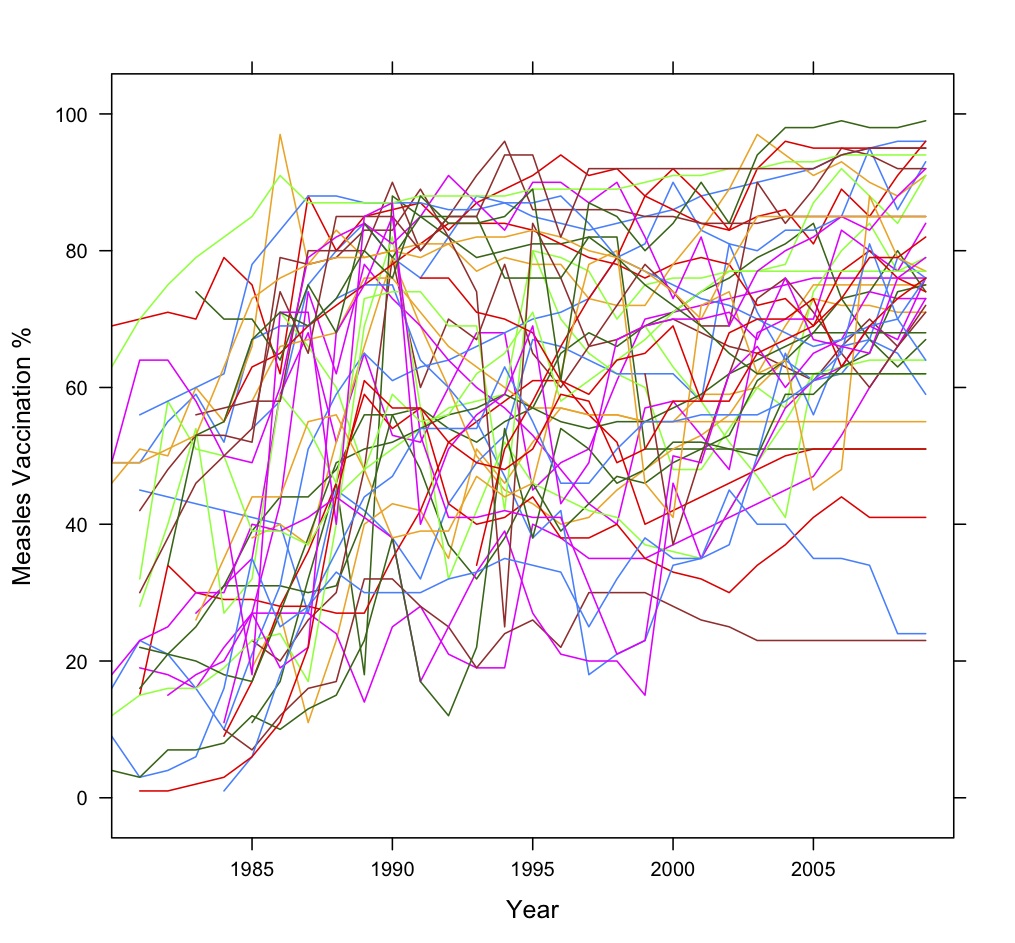
Since I am very far from Kampala, I have been spending time with health data instead. Today I was looking at immunization rates over time in sub-Saharan African countries. The colorful fruits of my labor, looking at measles, polio, and BCG (TB) are below. Each colored line represents a country:

Measles:

Polio (three shots):

BCG:


What can we make of these graphs? Well, it looks like measles vaccination rates tend to get “stuck” somewhere around 80% of coverage. Meanwhile, BCG coverage rates hit near 100% by the late 1980s in many countries. Polio has less clear patterns. Why is this? Is it a data problem? I’m not sure, but I’d like to find out.