As I prepare for (pretty fabulous) spinning class at Kabira gym (seriously, the bikes are great and the music bumping), I gingerly touch a black-and-blue right knee. You see, a few days ago as I was doing some laundry in the bathroom, I absentmindedly spilled some soapy water on the floor.
After hanging the delicates to dry, I bounded back into the bathroom and shwoooop! Down I went. Left leg out, right knee down, into what would have been the splits if I had been more flexible. My hand automatically flung out to grab the towel rack, but somehow in that moment I thought of the landlord and decided not to hang my weight on it.
Fortunately, all I suffered was a sore (and not split) knee, and my head remained far from the floor. But do you know that there are at least 9,000 deaths per year due to bathroom accidents in the U.S.? And there are over 230,000 non-fatal ER visits due bathroom injuries among those 15 years and older? Silly as it feels when you are splayed across your bathroom floor, this is surely no laughing matter.
I got up thanking my lucky stars I wasn’t elderly (or just positioned differently), for I surely would have broken something.
Bottom line: beware Omo on a wet floor! And don’t underestimate the power of the loo.
Some colleagues at APSA shared a new paper by Nunnenkamp and Öhler investigating the effect of official development assistance (ODA) on HIV-related health outcomes in developing countries. The authors write:
Optimally, ODA would help prevent new HIV infections as well as provide better care for the infected. Our results indicate that ODA-financed prevention has been insufficient to reduce the number of new HIV infections. By contrast, we find evidence of significant treatment effects on AIDS-related deaths for the major bilateral source of ODA, the United States.
However, the treatment effect proved to be insignificant when multilateral organizations represented the major source of ODA. In particular, our findings are in sharp conflict with claims of the most important organization in this field—the Global Fund to Fight AIDS, Tuberculosis, and Malaria—that its performance-based support has saved almost five million lives by the end of 2009.
It seems HIV/AIDS related foreign aid is coming under increasing scrutiny these days, at least by academics. Like Bendavid and Bhattacharya (2009), Nunnenkamp and Öhler find U.S.-funded PEPFAR associated with reduced deaths due to HIV/AIDS, but not reduced prevalence of HIV. The inability of billions of dollars to reduce new infections is troubling indeed.
The two lodges provided a very interesting contrast (while keeping ownership constant! errr…). Of course, there is far more to do around Paraa, including game drives and boat trips up to the foot of Murchison falls (do falls have feet?), and the lodge at Paraa is much more antiquated than the sparkling new Chobe. But the clientele is different as well. During the two days we spent at Paraa, the guests were almost exclusively European (many German, in fact). At Chobe, by contrast, a majority (by my eyeballed count) were Ugandan.
Pool at Chobe Lodge, overlooking the Nile
Why? There isn’t much in the way of a domestic tourism culture in Uganda, though park fees for East African citizens are a fraction of the cost for non-East Africans (though not explored here, developing domestic tourism is a topic that deserves a post of its own). So, my guess is that, since Paraa is quite far from any towns, it is not so cushy that one would go out of one’s way just for the ambiance of the lodge. It is mainly a comfortable, rustic place to sleep and eat between game drives and boating.
By contrast, it seems that many guests of Chobe are visiting from Gulu or other nearby urban centers, and are visiting for conferences and meetings, not to see sight-see — although there are some lovely sights to see (just not many animals). You can never get tired, for example, of the breathtaking view of the Nile. The hotel grounds and dining areas are also quite beautiful, and the rooms are much more elegant than Paraa (bed firmness notwithstanding). In short, the newly renovated lodge is a very comfortable place for those with the cash (politicians and NGOs alike) to get away for a weekend retreat. Chobe today could be considered the “Serena of Gulu”, for those of you familiar with the patrons of the Kampala branch of that hotel (h/t Angelo).
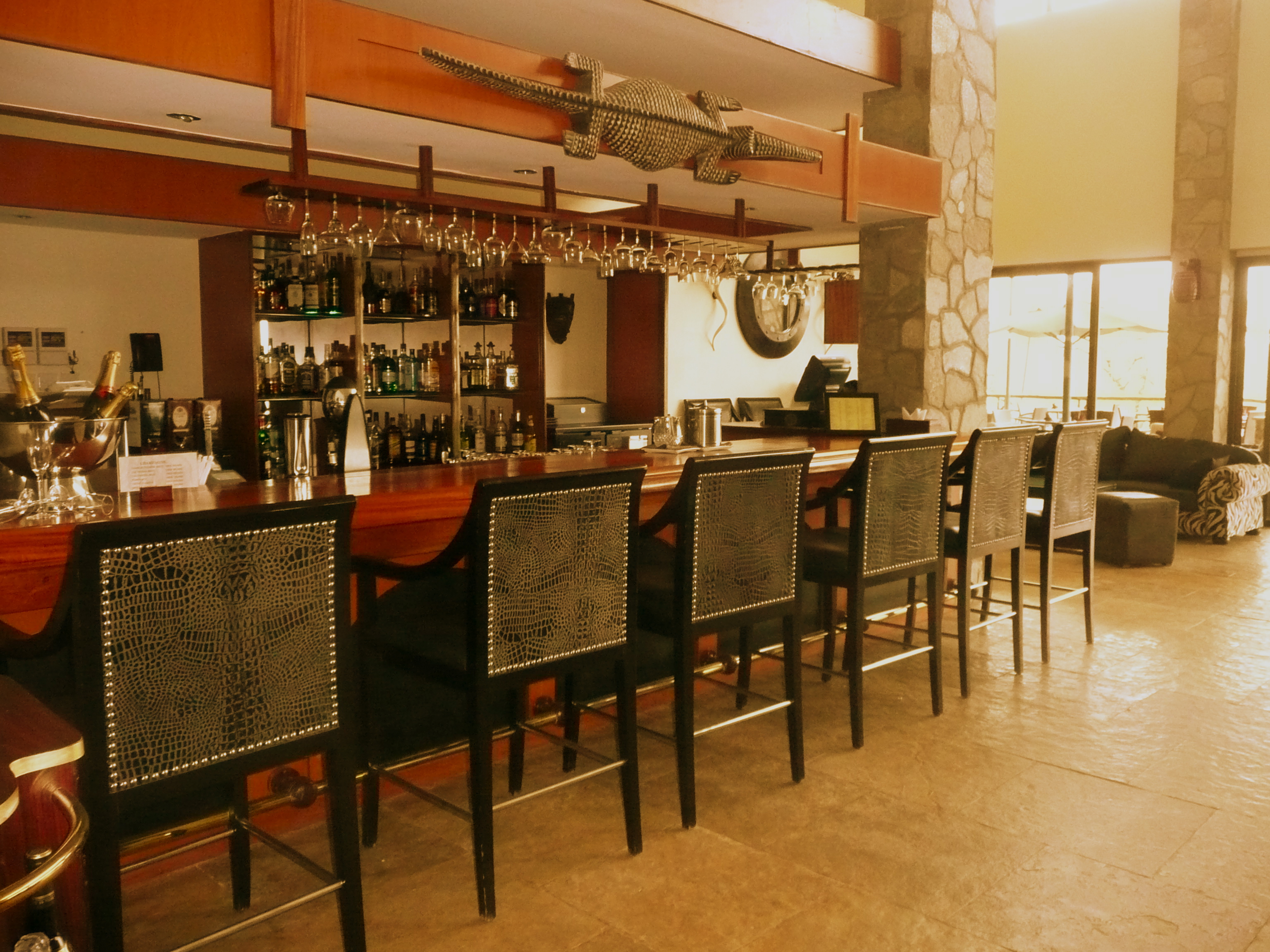
Plush bar, Chobe Lodge
The ambiance and clientele of Chobe may change as time goes on, and as the lodge develops more activities (a golf course has been proposed, for example). But for now it is a peaceful, if pricey, place to recharge for a few days. And the staff are fantastic.
Chobe is a short distance from Karuma falls, and is about 4 hours from Kampala, on good roads almost all the way. I’m happy to provide more details or a more extensive review to anyone interested in visiting.
My friend and co-author, Melissa Lee, is presenting our paper, “PEPFAR in Africa: Beyond HIV/AIDS”, today at the 2011 American Political Science Association annual conference. I have long wondered whether such a huge influx of health aid targeting a particular disease has a negative effect on the rest of the health sector. So, sometime earlier this year, Melissa and I decided to try to find out!
In our paper, we find that immunization and under-5 mortality rates in African PEPFAR recipient countries improved significantly less than in African non-recipient countries with HIV epidemics. The paper has not been uploaded yet, but I will share the link as soon as it is available.
The President’s Emergency Fund for AIDS Relief (PEPFAR) was initiated by President Bush in 2003, and is the largest bilateral aid program in the world that targets a single disease. By 2011, the U.S. government had committed $39 billion to the program, which often constitutes a large percentage, if not the majority, of health funding in PEPFAR recipient countries.
Empty corridors: rural hospital in Western Uganda, where PEPFAR spends more on HIV than the government spends on health
PEPFAR’s initial goals focused on prevention and treatment of HIV/AIDS, although they have recently expanded their strategy to include integrating PEPFAR into more general health programs. How successful has PEPFAR been in achieving these goals? They have helped provide anti-retroviral treatment to 3.2 million people, prophylaxis for 600,000 HIV+ pregnant women to prevent mother-to-child transmission, and supported 11 million people through other activities.
But a real evaluation of how well PEPFAR has performed must include a comparison to how well PEPFAR recipient countries would have performed in the absence of PEPFAR. Of course there is no way to go back in time and re-do history, but Eran Bendavid and Jay Bhattacharya in their 2009 paper use a difference-in-difference approach (as do Melissa and I) to evaluate the effect of PEPFAR on HIV outcomes such as HIV deaths, HIV prevalence, and the number of people living with HIV among African countries with an HIV epidemic. They find that while PEPFAR appears to have reduced deaths due to HIV/AIDS, HIV prevalence did not improve significantly in PEPFAR recipient countries when compared to non-recipient countries.
All told, the evidence on the effect of PEPFAR on both HIV and non-HIV health outcomes is mixed. Much more work needs to be done to determine why PEPFAR has been unable to reduce the prevalence of HIV, and the channels through which it negatively affects non-HIV related health outcomes such as child mortality and immunization rates.
This summer has been a time for reflection and celebration, and for welcoming new beginnings. As some of you may know, my best friend and partner, Angelo Izama and I got married…twice! And along with the name change has come a blog change – I am happy to announce the arrival of http://platas-izama.com!
And the world around us is changing fast too, for better or for worse. Just a year ago I attended the African Union summit meeting in Kampala, during which Gaddafi set up his own personal tent on the compounds of a resort hotel and his guards clashed with Ugandan security forces. Today the same man is on the run and reporters are touring his jet. What a difference a year can make.
With the relaunch of this blog/website I look forward to a lively discussion with you on all of this and much more — politics, development, research, and other tid bits. My hope is to be able to make this space more useful and informative for you (and me!), and to have some fun while doing so. I look forward to your comments, feedback, questions, and opinions. Thanks for reading!
I am very glad Dr. Besigye was ultimately allowed to fly (@AndrewMwenda suggests maybe he needs to invest in a boat now that walking, driving and flying are forbidden), but let’s remember why he needs to go to Nairobi in the first place (apart from his brutal treatment). There are no hospitals in Uganda that come close to rivaling the best of those of Kenya or South Africa. Those who get care in Mulago or IHK are the luckiest.
Beyond the overburdened national referral hospital and private hospitals (the latter of which are impossibly expensive for most), the health sector in Uganda is in a pathetic state. Health worker absenteeism, drug leakage, and even ghost clinics are rampant. A 2007 survey found that only 6% of Uganda’s hospitals had the basic infection control elements (soap, running water, latex gloves, etc.). 1 in 8 children will not live to see their first birthday, meaning that nearly 500 of the 4000+ born each day will have died within the next five years. Maternal mortality has not improved by any statistically significant amount from 1995 to 2006, when the last Demographic and Health study was completed (Uganda DHS 2006 pg.282).
The failures of the health sector are to a large extent, a failure of governance.
Yes, it is terrible that security forces attempted to stop Besigye from seeking the medical treatment he so desperately needs and deserves. It literally added insult to a horribly unjust injury. But even more terrible is that Besigye is only one of millions of Ugandans who desperately need quality health care. And most aren’t getting it.
Kizza Besigye was today arrestedagain, this time even more brutally than the last.
Many claim that Museveni has now lost it — this is the kind of brutality not seen since the days of Amin. But back then, such things were whispers in the dark, rumors you hoped weren’t all true. Today they are broadcast far and wide for all to see.
But if the state (read: Museveni) appears in disarray, so too does the movement opposing it. Anger, not vision, drives people to the streets. Not one Uganda, one people, but one Besigye who has been brutalized. The campaign is still more anti-Museveni than pro-anything.
As Andrew Mwenda says, Uganda is barreling down a highway, facing four exits: Exit Saudi Arabia, where protests go to die, Exit Yemen where stalemate prevails, Exit Egypt with transformative revolution, and Exit Libya, where civil war reigns.
The problem is that this bus is unmanned, and traveling at high speeds. Which exit will Uganda take? Ordinarily one could try to predict the outcome by the relative organization of either side — Museveni or Besigye/opposition. But disorder and chaos abound on both sides. Thus, the outcome is to a large extent vulnerable to random chance. An accidental gunshot, a careless arrest, a viral video. All these can send the unmanned bus veering off wildly. Who will grab the wheel then?
Angelo Izama and Andrew Mwenda discuss Ugandan politics in the context of the current unrest and revolution in north Africa on Upfront Africa Voice of America. Listen here.
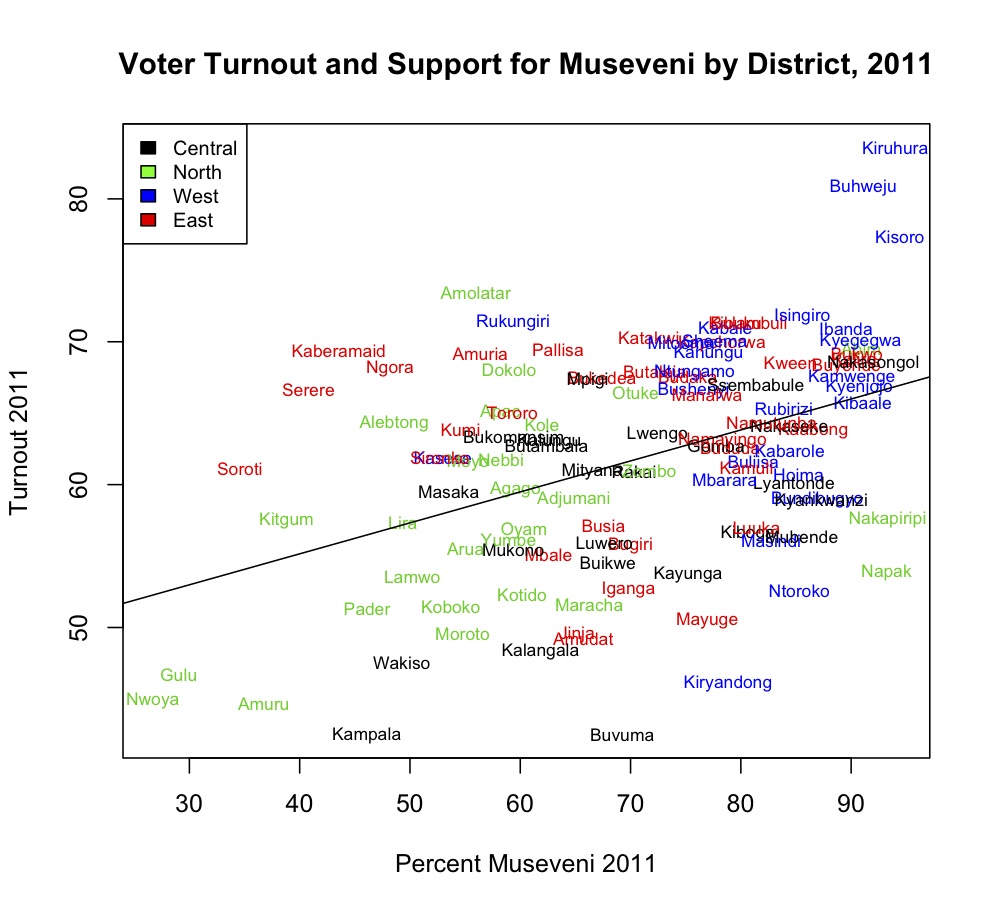
I’ve been looking at the 2011 Ugandan presidential election data on voter turnout and support for Museveni by district. The trends mirror those in the 2001 and 2006, which I reported on in the Independent, and which Elliot Green also examined in his post-election blog post.
Voter turnout appears to be higher in districts that have greater support for Museveni. This relationship appears robust across the past three elections and even within regions. The question, of course, is what explains this trend? Is it that NRM is better at getting out the vote in it’s strongholds? There is more rigging going on in NRM strongholds? Opposition is apathetic and feels their vote won’t matter, so they stay home on polling day? Other ideas? I’m currently brainstorming ways to test these explanations, which are not mutually exclusive. Any and all ideas welcome.

 fered was a sore (and not split) knee, and my head remained far from the floor. But do you know that there are at least 9,000 deaths per year due to bathroom accidents in the U.S.? And there are over 230,000 non-fatal ER visits due bathroom injuries among those 15 years and older? Silly as it feels when you are splayed across your bathroom floor, this is surely no laughing matter.




 Melina Raquel Platas