Beyond the State: Letters from Gulu

Apologies for the extremely sparse posting of late. I have just returned from a trip to Central America, including Belize, Honduras, and Mexico, which I’ll post more about soon. In the meantime, I’d like to share the first edition of a weekly column I began writing for the Independent (Rwanda edition) three weeks ago. I’ll be posting these weekly after they are published online. I look forward to your comments and feedback.

Beyond the state: letters from Gulu

Published online November 23, 2011

Health care, education, basic infrastructure, and security are some of the services the modern state seeks to provide. The success of states in delivering these goods to their far-flung populations, especially in the midst of conflict or under severe resource constraints, is quite variable. In recent years, for example, Rwanda has been lauded for implementing a health insurance scheme that covers all Rwandans and offers them a range of health services, while the reach of the state in countries like the Democratic Republic of Congo or South Sudan is much more limited. While there are important lessons to be learned from the success of the Rwandan state, which has proven itself unusually efficacious in a number of sectors, it is all too easy to overlook the ways in which information and innovation flow alongside the state, and often in spite of state failures. Tremendous opportunity lies beyond the state.

I recently unearthed letters given to me in mid-2005 by a group of primary school students in Gulu, northern Uganda’s largest city, illustrating this point. At the time, to cross Karuma Falls, where the Nile cuts the land like a scythe, was to enter a world far removed from political drama unfolding in Kampala. While Ugandan President Museveni was jostling for the removal of term limits in the capital, the terror of the Lord’s Resistance Army (LRA) in northern Uganda was still unfolding, though nearing its final days. The river dividing north from south might as well have been an ocean.

The reach and strength of the state was limited. Getting to Gulu from the capital carried its risks – tarmac fell away at the edges of the road much of the way from Kampala to Karuma, rebels lingered somewhere north of the Nile, and reaching the environs beyond Gulu was an even greater challenge. The state could not guarantee security, much less provide quality public services. Then Prime Minister, Apolo Nsibambi, in charge of public sector management, did not even set foot in the north until the mid 2000s, more than five years into his term.

When I first received the letters, I was struck by the violent images many of the children in Gulu could portray with a couple of pens and a piece of paper. Looking back, however, more striking than these images are what these youngsters wrote. “Too many children one after the other”, wrote a young boy named Geoffrey. “If a woman is not allowed to rest between children, her reproductive system can be harmfully affected, and her children will not be properly cared for”. Another, Solomon, carefully printed Ghanaian Nobel laureate Raphael Armattoe’s poem, “The Lonely Soul”, word for word. Others wrote about the effect of AIDS on their community, and a young boy named Kenneth drew a picture of “Cent 50”, the American rapper.

These letters illustrate not the failure of the Ugandan state in the north, which had evidently been unwilling or unable to stop the marauding LRA for nearly twenty years, but rather the porous nature of society, and the tremendous opportunities that lie outside the state. These students demonstrate not the dismal quality of Uganda’s educational system in an insecure region, but rather their ability to utilize the resources at their young fingertips. At ages seven to ten, they shared information about child spacing, antenatal care, infertility, the spread of infectious disease, poetry, and American pop culture. Through what channels did they initially access this information? Through school and formal state structures? Possibly, though these are likely to be only part of the story. How can we use these channels, whatever they may be, to further promote innovation and the spread of information?

Our approaches to improving public health and education have often focused on things we can touch and see – a health center, a new classroom, an operating table, a chalkboard – but ignored the social networks and flow of information that do not respect administrative boundaries and are not tied to specific politicians and policies. This bias is in part due to the fact that physical infrastructure is highly visible, and as such, plays an important role in politics. It is much harder to see the networks of common knowledge than it is to see the building of walls. It is easy to undervalue and difficult to use that which we cannot see, at least politically. We tend to privilege infrastructure over information.

How do we take advantage of the vibrant flow of information today? How can we better understand the channels through which it flows – through communities, families, churches, mosques, media, and even music? The state is not the only, or even primary, conduit of knowledge with the potential to improve health, for example. The formal structures of the state and public service provision often seem to fail us – absenteeism among civil servants, rampant corruption, poor policy implementation – but the social structures that connect society have the potential to fill in the gaps.

What is remarkable is not how far we have to go in ensuring a minimum standard of living, which can seem like a daunting journey, but how far we have come, even in the midst of conflict and severe resource constraints. The state can and should play an important and perhaps guiding role in providing public services, but we should also try to understand and take advantage of the opportunities to improve health, education, and other social services already at our fingertips.
Childhood vaccination in sub-Saharan Africa

First of all, if you are in Kampala and interested in health, don’t miss the health journalism conference hosted by the Health Journalists Network in Uganda taking place today at Hotel Africana. Follow HEJNU on twitter for live updates here.

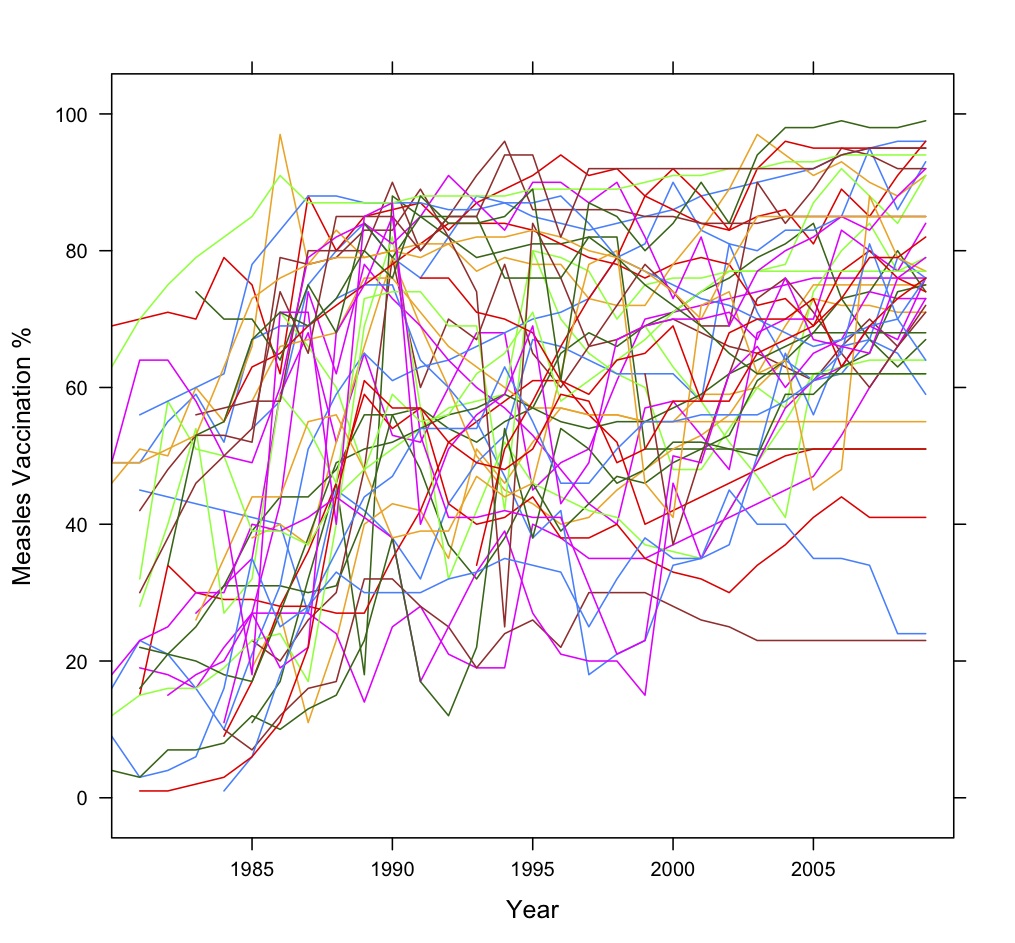
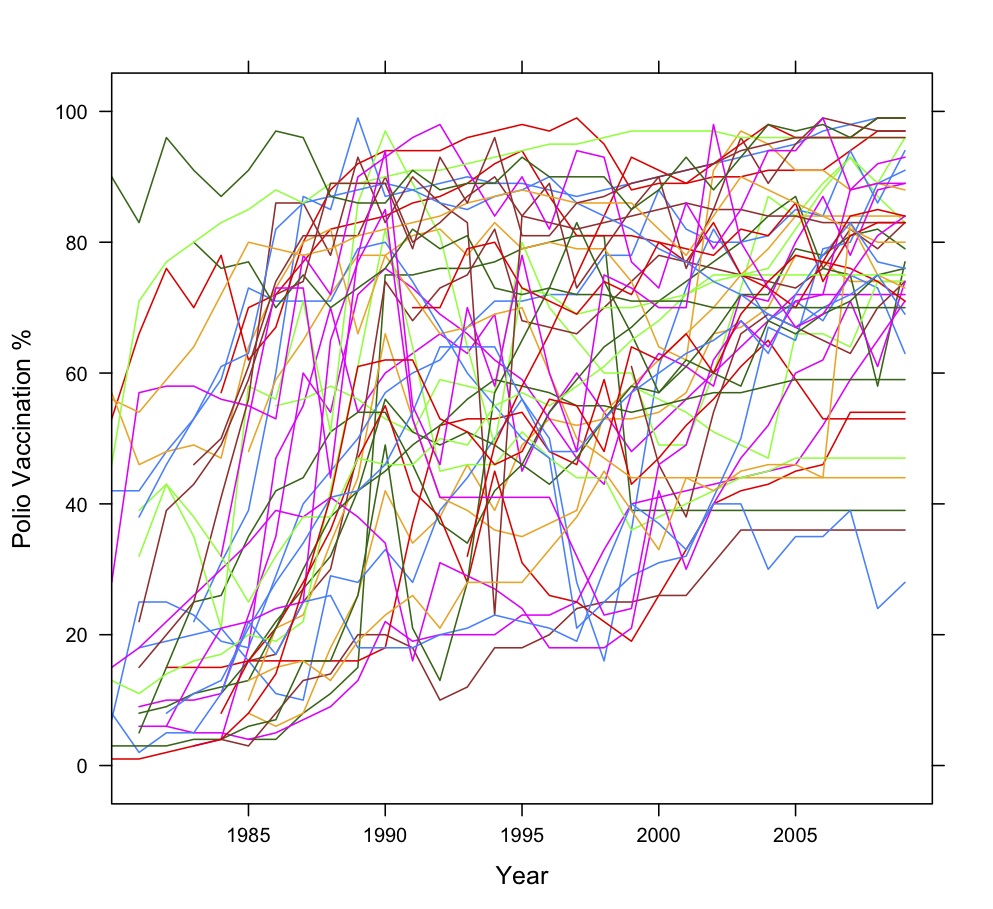
Since I am very far from Kampala, I have been spending time with health data instead. Today I was looking at immunization rates over time in sub-Saharan African countries. The colorful fruits of my labor, looking at measles, polio, and BCG (TB) are below. Each colored line represents a country:

Measles:

Polio (three shots):

BCG:


What can we make of these graphs? Well, it looks like measles vaccination rates tend to get “stuck” somewhere around 80% of coverage. Meanwhile, BCG coverage rates hit near 100% by the late 1980s in many countries. Polio has less clear patterns. Why is this? Is it a data problem? I’m not sure, but I’d like to find out.

Does results-based financing in health work?

I’ve been reading “An overview of research on the effects of results-based financing,” published by the Norwegian Knowledge Centre for Health Services, which discusses ten reviews of RBF schemes in low and middle-income countries (LMIC). What did they find?

  • “Conditional cash transfer (CCT) programmes have been found to be effective at increasing the uptake of some preventive services which were already free.”
  • “The success of CCT depends on the existence of effective primary health services and local infrastructures.”
  • “Although financial incentives are considered to be an important element of strategies to change professional practice, there are relatively few well-designed studies and overall the evidence is weak.
  • “A small number of more rigorous evaluations have examined relatively simple preventive interventions, such as the impact on rates of immunizations and screenings, as opposed to more complex interventions. The success of a financial incentive is likely to be inversely related to the complexity of the tasks it seeks to motivate.”

Overall, it appears the quality of evaluation of RBF schemes has been relatively poor. The available evidence suggests we need to look more carefully at the (perhaps very specific) conditions under which RBF can work. I’m afraid RBF might not work well in the public sector in the absence of fairly strong government support and political commitment to the project. But that is something to be explored…

it’s about that time again

Time to make the trek across the globe that is. Entebbe-San Francisco, via Addis and Dubai. I’m getting back just in time for classes to begin on Monday, and looking forward to TAing for a new crop of students in Democracy, Development, and the Rule of Law, taught by Larry Diamond and Kathryn Stoner-Weiss.

In other news?

  • Opposition leader Michael Sata wins the presidency in Zambia. My good friend and fellow grad student Ken Opalo was in Zambia this week and has been writing about the election here. He suggests following @LoiusRedvers for updates.
  • Some snooping around suggests the flu that is still harassing me is quite widespread around Kampala. Friends who have gone to the Surgery and IHK with symptoms said they were told there is a severe strain going around. Perhaps it has peaked by now, but I wonder if the Ministry of Health shouldn’t have put out some kind of message. A fever that jumps from normal to 102 F (with ibuprofen!) in a matter of hours is no joke, especially for young kids and the elderly. Ok, end rant.
  • For those of you in the Bay Area, Stanford Professor Beatriz Magaloni and several others are organizing a conference on violence in Mexico: “Violence, Drugs, and Governance: Mexican Security in Comparative Perspective.” Speakers include Steve Krasner, Francis Fukuyama, David Kennedy, Karl Eikenberry, and many more. Not to be missed!
  • Another conference to put on the calendar is “Redefining Security Along the Food/Health Nexus,” hosted by Stanford’s Freeman Spogli Institute. Keynote speakers include Kofi Annan and Robert Gates.

I can now no longer put off packing, so that’s all for now.

I’ll see if I can get some wi-fi in Dubai. Otherwise, I’ll see you on the other side.

UPDATE:

I know, you thought I was packing. So did I. But I just read that the Uganda Shilling has fallen to an 18-year low – Ushs2901 to the dollar, according to Reuters. Annnnnd, the power just went out. Tough times indeed.

felled by fever

As my partner-in-crime was felled by a fever this weekend, I got to wondering how often people treat themselves for malaria when they really have a nasty virus, flu or otherwise. If you don’t have the time, resources, or energy, it might seem like a good idea to pop some anti-malarials (assuming you can get them) just in case.

I gave a presentation about health services and malaria in Uganda several weeks ago, in which, among other things, I bemoaned the lack of attention malaria receives from government. Browsing various publications, studies, and policy reports, I mentioned several stats, including the following:

  • Malaria is the cause of 32% of child deaths in Uganda (DHS Child Verbal Autopsy 2007)
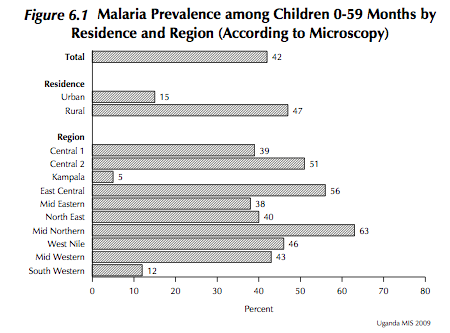
  • 42% of children tested positive for malaria during the DHS Malaria Indicator Survey 2009 , compared to 0.7% in Ethiopia, 2.6% in Rwanda, 7.6% in Kenya, and 18% in Tanzania.
  • Malaria is responsible for 30-50% of all outpatient visits, 15-20% of all admissions, and 9-14% of all inpatient deaths
  • Uganda ranks third in the world in terms of malaria deaths

One of the audience members asked about the accuracy of reporting of malaria cases in Uganda. While malaria is undeniably one of the most important health challenges Uganda faces, it is important to acknowledge that the capacity to diagnose malaria is generally weak, and many if not most of the malaria cases and deaths are not laboratory confirmed. There is probably a sizable chunk of these “malaria cases” that are not actually malaria, but rather a flu or some other virus or infection.

The 2009 Malaria Indicator Survey found that of the 3,727 children included in the survey, 44.7% were reported to have had a fever in the preceding two weeks. While 70% of children with fever were taken to a health facility or health provider, only 17% were reported as having been tested for malaria through a finger or heel prick. 60% of children with fever ended up taking anti-malarials, and 15% took antibiotics.

I’m still astounded that 42% of the children in the survey tested positive for malaria (62% were anemic). This figure is especially high when you compare it with other countries in the East African region (see above). Prevalence varies quite a bit by region as well.

Source: Uganda Malaria Indicator Survey 2009, page 61.

The internet has slowed to a crawl, but I’ll post some more links on this soon.

141,000 child deaths in Uganda per year

That according to the recently released 2011 UN report, “Levels and Trends in Child Mortality“. For a relatively small country of around 32 million inhabitants, Uganda gets a terribly large chunk of the pie, as seen below (page 8 of the report). Uganda is the 10th largest contributor to child deaths worldwide.

The good news?

In Sub-Saharan Africa the average annual rate of reduction in under-five mortality has accelerated, doubling from 1990-2000 to 2000-2010. Six of the fourteen best-performing countries are in Sub-Saharan Africa, as are four of the five countries with the largest absolute reductions (more than 100 deaths per 1,000 live births).

The six best performers for a reduction in the rate of mortality are Madagascar, Malawi, Eritrea, Liberia, Niger, and Tanzania. The countries with the greatest reduction in child deaths in absolute terms are Niger, Malawi, Liberia, and Sierra Leone. What are they doing right?

reading in global health: ACCESS

Several months ago I downloaded ACCESS: How do good health technologies get to poor people in poor countries?, a book listed on Karen Grepin‘s excellent global health recommended reading list, but only just now have gotten around to reading it.

What is “access” in this context?

Stated simply, access refers to people’s ability to obtain and appropriately use good quality health technologies when they are needed. Access is not only a technical issue involving the logistics of transporting a technology from the manufacturer to the end-user. Access also involves social values, economic interests, and political processes. Access requires a product as well as services and is linked to how health systems perform in practice. We think of access not as a single event but as a process involving many activities and actors over time. Access is not a yes-or-no dichotomous condition, but rather a continuous condition of different degrees; more like a rheostat than an on-off switch.

Understanding the factors that help or hinder access to health technologies is a topic I am hoping to explore further in my own dissertation, so I’m looking forward to reading the rest of the book. ACCESS is available as a free download.

Earlier this summer, I read another of Karen Grepin’s suggestions, The Making of a Tropical Disease: A Short History of Malaria. It was fascinating, and highly recommended. I will post some excerpts and “fun” facts I learned soon. This one isn’t available as a free download, but is available on Kindle. And yes, I am a Kindle Convert.

Impact evaluation and RCTs in health

I am currently working on a proposal for a pilot of performance-based contracts (PBC) in Uganda’s health sector, and have been busy navigating the literature out there. Fortunately for me, there is also a lot of discussion on randomized controlled trials (RCTs) and impact evaluation in the development blogosphere of late.

Today I’ve been reading “Performance Incentives for Global Health,” published by the Center for Global Development, and available for purchase or downloadable chapter-by-chapter here. It has proven very useful so far in helping me think through the various ways in which PBC pilots could be designed. In Chapter 5, A Learning Agenda, the authors write:

Impact evaluation is more than a tool for gauging impacts at the end of a program and providing the inputs into a cost-effective analysis. It can also help a program to evolve. For example, in the initial phase of a pay-for-performance program, three contracts with different risk levels can be piloted. Based on the results from an early evaluation, the most effective contract can be scaled up. Several parameters lend themselves to this kind of experimentation, including the relative effects of supply versus demand interventions, the level of rewards offered for performance, and the balance of trade-offs between access and use.

Rwanda is often noted as a pay-for-performance (P4P) success story, and Chapter 10 is devoted to this case study. The original study by Basinga et al. (2010) is available here (and co-authored by Rwanda’s current Minister of Health, Agnes Binagwaho, also available at @agnesbinagwaho). The authors find that P4P has a significant effect on the number of deliveries in health facilities, quality of prenatal care, and number of preventive care visits for children, but they find no effect on the number of prenatal care visits or immunizations.

In Uganda, a similar pilot, this time of private-not-for-profit (PNFP) facilities, found no effect of bonuses on health facilities’ performance in achieving self-selected health targets. They did find that financial autonomy improved health facilities’ performance, however. The study, “Contracting for Primary Health Care in Uganda”, remains an unpublished World Bank manuscript, as far as I can tell (publication bias at work), but the slides from the 2007 CGD presentation are available here.

I’d like to examine the effect of PBC on health outcomes in the public rather than PNFP sector (hopefully using a few variations of the contract “treatment”), as well as better understand why performance-based pay (in the form of bonuses) did not seem to have an effect on health outcomes in the Uganda pilot. Finally, I am interested in understanding the relative efficacy of supply-side (such as PBC) vs. demand-side (such as conditional cash transfers) efforts in improving various health outcomes. More updates on this to come.

Throwing aid at HIV

Some colleagues at APSA shared a new paper by Nunnenkamp and Öhler investigating the effect of official development assistance (ODA) on HIV-related health outcomes in developing countries. The authors write:

Optimally, ODA would help prevent new HIV infections as well as provide better care for the infected. Our results indicate that ODA-financed prevention has been insufficient to reduce the number of new HIV infections. By contrast, we find evidence of significant treatment effects on AIDS-related deaths for the major bilateral source of ODA, the United States.

However, the treatment effect proved to be insignificant when multilateral organizations represented the major source of ODA. In particular, our findings are in sharp conflict with claims of the most important organization in this field—the Global Fund to Fight AIDS, Tuberculosis, and Malaria—that its performance-based support has saved almost five million lives by the end of 2009.

It seems HIV/AIDS related foreign aid is coming under increasing scrutiny these days, at least by academics. Like Bendavid and Bhattacharya (2009), Nunnenkamp and Öhler find U.S.-funded PEPFAR associated with reduced deaths due to HIV/AIDS, but not reduced prevalence of HIV. The inability of billions of dollars to reduce new infections is troubling indeed.

PEPFAR in Africa: Success or Failure?

My friend and co-author, Melissa Lee, is presenting our paper, “PEPFAR in Africa: Beyond HIV/AIDS”, today at the 2011 American Political Science Association annual conference. I have long wondered whether such a huge influx of health aid targeting a particular disease has a negative effect on the rest of the health sector. So, sometime earlier this year, Melissa and I decided to try to find out!

In our paper, we find that immunization and under-5 mortality rates in African PEPFAR recipient countries improved significantly less than in African non-recipient countries with HIV epidemics. The paper has not been uploaded yet, but I will share the link as soon as it is available.

The President’s Emergency Fund for AIDS Relief (PEPFAR) was initiated by President Bush in 2003, and is the largest bilateral aid program in the world that targets a single disease. By 2011, the U.S. government had committed $39 billion to the program, which often constitutes a large percentage, if not the majority, of health funding in PEPFAR recipient countries.

Empty corridors: rural hospital in Western Uganda, where PEPFAR spends more on HIV than the government spends on health

PEPFAR’s initial goals focused on prevention and treatment of HIV/AIDS, although they have recently expanded their strategy to include integrating PEPFAR into more general health programs. How successful has PEPFAR been in achieving these goals? They have helped provide anti-retroviral treatment to 3.2 million people, prophylaxis for 600,000 HIV+ pregnant women to prevent mother-to-child transmission, and supported 11 million people through other activities.

But a real evaluation of how well PEPFAR has performed must include a comparison to how well PEPFAR recipient countries would have performed in the absence of PEPFAR. Of course there is no way to go back in time and re-do history, but Eran Bendavid and Jay Bhattacharya in their 2009 paper use a difference-in-difference approach (as do Melissa and I) to evaluate the effect of PEPFAR on HIV outcomes such as HIV deaths, HIV prevalence, and the number of people living with HIV among African countries with an HIV epidemic. They find that while PEPFAR appears to have reduced deaths due to HIV/AIDS, HIV prevalence did not improve significantly in PEPFAR recipient countries when compared to non-recipient countries.

All told, the evidence on the effect of PEPFAR on both HIV and non-HIV health outcomes is mixed. Much more work needs to be done to determine why PEPFAR has been unable to reduce the prevalence of HIV, and the channels through which it negatively affects non-HIV related health outcomes such as child mortality and immunization rates.