Tackling Global Health: Women and Water

Below is my column, online this week, for the Rwanda Edition of the Independent magazine.

Tackling Global Health: Women and Water

Published online November 29, 2011

History suggests that women and water are essential in conquering the developing world’s health challenges

World Toilet Day came and went without much fanfare. In between using the toilet yourself, you probably missed it. Talking about toilets is not sexy, and discussing water and sanitation is probably not at the top of your list, but it should be. Women and water, specifically clean water, have been responsible for major improvements in health in the developed world and hold enormous potential for tackling its health challenges.

At the turn of the 20th century, some of the top killers in the United States included tuberculosis, pneumonia, typhoid, meningitis, influenza, and diarrhea (for children under two years of age).  In 1900, approximately one in six American babies would not live to see their first birthday, according to one recent estimate. In just thirty years, however, infant deaths in the U.S. had fallen by more than half, to an estimated 70 deaths per 1000, approximately equivalent to infant mortality rates in Rwanda today. What accounts for this tremendous improvement in child health in America?

It is tempting to suggest that new medical technologies led to massive improvements in health, and particularly child health. In the course of the 20th century we saw an unprecedented period of medical innovation, which ultimately led to the widespread availability of life-saving vaccines, antibiotics, and other medical technologies we take for granted today. But what is remarkable is that the decline in mortality, particularly due to infectious disease, occurred before the spread, and often before the invention, of these technologies.

Deaths due to scarlet fever had fallen to nearly zero by the time penicillin, a common antibiotic today, was invented in 1946. Similarly, deaths from typhoid and tuberculosis fell dramatically before the introduction of antibiotics to treat these bacterial infections were invented in 1948 and 1950, respectively. It was not until 1963 that a vaccine to prevent measles was invented, by which point very few people died of measles in the U.S. Most of the decline in mortality from infectious diseases in the U.S. occurred before the introduction of medical technology used to prevent or treat them.

So what accounts for the decline in mortality due to infectious disease? To a large extent, women and water. Recent research by Grant Miller of Stanford University finds that women’s suffrage in the U.S. directly contributed to increases in public health spending in the 1920s. Much of this health spending went toward public campaigns to improve hygiene. Around 20,000 child deaths were averted as better hygiene prevented the spread of deadly infectious diseases. Miller argues that legislators anticipated women support of public funding for health, and voted for more progressive public reforms as soon as they won the right to vote.

In related work, Miller and economist David Cutler find that improvements in water systems in the U.S. between 1900 and 1940, specifically filtration and chlorination, contributed to three quarters of the decline in infant mortality and two thirds of the decline in child mortality during this period. Waterborne diseases were responsible for a large proportion of deaths during this time, particularly in U.S. cities, and water treatment and filtration led to a major decline in these waterborne illnesses.

Today, over one billion people around the world do not have access to clean water, and over two billion to not have access to sanitation facilities. In Rwanda, only an estimated 23 percent of the population had access to adequate sanitation in 2006, and in Uganda only 33 percent. In Uganda’s capital city, Kampala, only eight percent of homes are connected to a sewage line. A greater proportion of the population have access to clean water—64 percent in Uganda and 65 percent in Rwanda—but nearly one third of the population continues to consume unsafe water on a daily basis.

Much of the emphasis on public health today focuses on supply-side factors – on health care rather than health, on curative rather than preventive treatments, on hospitals rather than homes. But history suggests that the greatest improvements in health have taken place within the home, with a focus on preventing infectious disease rather than treating it. Women play a key role in this process. Women are more likely to be in charge of feeding children and ensuring their homes have clean water and adequate sanitation, and some research suggests women tend to place greater value on child welfare (this is why cash transfers programs often target women in the household, rather than men). As we have seen in the U.S., women voters can have a profound impact on legislator behavior and consequently, public policy.

Survey evidence from the Afrobarometer suggests that health is a major concern for ordinary Ugandans, and populations throughout sub-Saharan Africa. In 2011, 26 percent of Ugandans said that “improving public services such as education and health” was their top concern, and 50 percent said that health was among the “most important problems facing this country that the forthcoming 2011 elections should address,” and ranked health higher than any of the thirty-odd other policy issues. Whether legislators act on the policy preferences of their constituents is another matter altogether. Nevertheless, the potential of the electorate, and women in particular, to influence public policy should be taken seriously, especially with regard to health.

A focus on hygiene may be as efficacious, if not more so, than the antibiotics and antimalarial drugs that are ubiquitous in public health today. The difference between 1920s America and the developing world in 2011 is that we are not forced today to rely on prevention of disease, because the momentous gains in medical technology allow us to treat the most common causes of death and disability. But this new technology should not become a crutch, and we should not forget the tremendous gains in population health that can be made by focusing on hygiene rather than a vaccine. Toilets may not be sexy, but life without adequate sanitation just stinks.

Beyond the State: Letters from Gulu

Apologies for the extremely sparse posting of late. I have just returned from a trip to Central America, including Belize, Honduras, and Mexico, which I’ll post more about soon. In the meantime, I’d like to share the first edition of a weekly column I began writing for the Independent (Rwanda edition) three weeks ago. I’ll be posting these weekly after they are published online. I look forward to your comments and feedback.

Beyond the state: letters from Gulu

Published online November 23, 2011

Health care, education, basic infrastructure, and security are some of the services the modern state seeks to provide. The success of states in delivering these goods to their far-flung populations, especially in the midst of conflict or under severe resource constraints, is quite variable. In recent years, for example, Rwanda has been lauded for implementing a health insurance scheme that covers all Rwandans and offers them a range of health services, while the reach of the state in countries like the Democratic Republic of Congo or South Sudan is much more limited. While there are important lessons to be learned from the success of the Rwandan state, which has proven itself unusually efficacious in a number of sectors, it is all too easy to overlook the ways in which information and innovation flow alongside the state, and often in spite of state failures. Tremendous opportunity lies beyond the state.

I recently unearthed letters given to me in mid-2005 by a group of primary school students in Gulu, northern Uganda’s largest city, illustrating this point. At the time, to cross Karuma Falls, where the Nile cuts the land like a scythe, was to enter a world far removed from political drama unfolding in Kampala. While Ugandan President Museveni was jostling for the removal of term limits in the capital, the terror of the Lord’s Resistance Army (LRA) in northern Uganda was still unfolding, though nearing its final days. The river dividing north from south might as well have been an ocean.

The reach and strength of the state was limited. Getting to Gulu from the capital carried its risks – tarmac fell away at the edges of the road much of the way from Kampala to Karuma, rebels lingered somewhere north of the Nile, and reaching the environs beyond Gulu was an even greater challenge. The state could not guarantee security, much less provide quality public services. Then Prime Minister, Apolo Nsibambi, in charge of public sector management, did not even set foot in the north until the mid 2000s, more than five years into his term.

When I first received the letters, I was struck by the violent images many of the children in Gulu could portray with a couple of pens and a piece of paper. Looking back, however, more striking than these images are what these youngsters wrote. “Too many children one after the other”, wrote a young boy named Geoffrey. “If a woman is not allowed to rest between children, her reproductive system can be harmfully affected, and her children will not be properly cared for”. Another, Solomon, carefully printed Ghanaian Nobel laureate Raphael Armattoe’s poem, “The Lonely Soul”, word for word. Others wrote about the effect of AIDS on their community, and a young boy named Kenneth drew a picture of “Cent 50”, the American rapper.

These letters illustrate not the failure of the Ugandan state in the north, which had evidently been unwilling or unable to stop the marauding LRA for nearly twenty years, but rather the porous nature of society, and the tremendous opportunities that lie outside the state. These students demonstrate not the dismal quality of Uganda’s educational system in an insecure region, but rather their ability to utilize the resources at their young fingertips. At ages seven to ten, they shared information about child spacing, antenatal care, infertility, the spread of infectious disease, poetry, and American pop culture. Through what channels did they initially access this information? Through school and formal state structures? Possibly, though these are likely to be only part of the story. How can we use these channels, whatever they may be, to further promote innovation and the spread of information?

Our approaches to improving public health and education have often focused on things we can touch and see – a health center, a new classroom, an operating table, a chalkboard – but ignored the social networks and flow of information that do not respect administrative boundaries and are not tied to specific politicians and policies. This bias is in part due to the fact that physical infrastructure is highly visible, and as such, plays an important role in politics. It is much harder to see the networks of common knowledge than it is to see the building of walls. It is easy to undervalue and difficult to use that which we cannot see, at least politically. We tend to privilege infrastructure over information.

How do we take advantage of the vibrant flow of information today? How can we better understand the channels through which it flows – through communities, families, churches, mosques, media, and even music? The state is not the only, or even primary, conduit of knowledge with the potential to improve health, for example. The formal structures of the state and public service provision often seem to fail us – absenteeism among civil servants, rampant corruption, poor policy implementation – but the social structures that connect society have the potential to fill in the gaps.

What is remarkable is not how far we have to go in ensuring a minimum standard of living, which can seem like a daunting journey, but how far we have come, even in the midst of conflict and severe resource constraints. The state can and should play an important and perhaps guiding role in providing public services, but we should also try to understand and take advantage of the opportunities to improve health, education, and other social services already at our fingertips.

Impact evaluation and RCTs in health

I am currently working on a proposal for a pilot of performance-based contracts (PBC) in Uganda’s health sector, and have been busy navigating the literature out there. Fortunately for me, there is also a lot of discussion on randomized controlled trials (RCTs) and impact evaluation in the development blogosphere of late.

Today I’ve been reading “Performance Incentives for Global Health,” published by the Center for Global Development, and available for purchase or downloadable chapter-by-chapter here. It has proven very useful so far in helping me think through the various ways in which PBC pilots could be designed. In Chapter 5, A Learning Agenda, the authors write:

Impact evaluation is more than a tool for gauging impacts at the end of a program and providing the inputs into a cost-effective analysis. It can also help a program to evolve. For example, in the initial phase of a pay-for-performance program, three contracts with different risk levels can be piloted. Based on the results from an early evaluation, the most effective contract can be scaled up. Several parameters lend themselves to this kind of experimentation, including the relative effects of supply versus demand interventions, the level of rewards offered for performance, and the balance of trade-offs between access and use.

Rwanda is often noted as a pay-for-performance (P4P) success story, and Chapter 10 is devoted to this case study. The original study by Basinga et al. (2010) is available here (and co-authored by Rwanda’s current Minister of Health, Agnes Binagwaho, also available at @agnesbinagwaho). The authors find that P4P has a significant effect on the number of deliveries in health facilities, quality of prenatal care, and number of preventive care visits for children, but they find no effect on the number of prenatal care visits or immunizations.

In Uganda, a similar pilot, this time of private-not-for-profit (PNFP) facilities, found no effect of bonuses on health facilities’ performance in achieving self-selected health targets. They did find that financial autonomy improved health facilities’ performance, however. The study, “Contracting for Primary Health Care in Uganda”, remains an unpublished World Bank manuscript, as far as I can tell (publication bias at work), but the slides from the 2007 CGD presentation are available here.

I’d like to examine the effect of PBC on health outcomes in the public rather than PNFP sector (hopefully using a few variations of the contract “treatment”), as well as better understand why performance-based pay (in the form of bonuses) did not seem to have an effect on health outcomes in the Uganda pilot. Finally, I am interested in understanding the relative efficacy of supply-side (such as PBC) vs. demand-side (such as conditional cash transfers) efforts in improving various health outcomes. More updates on this to come.

copycats

Well, entirely unsurprisingly the Ugandan army has been accused of war crimes in the DRC in a recently leaked draft UN report. The foreign minister, Sam Kutesa, has suggested that the publication of such a report might “undermine” Uganda’s resolve in contributing to and participating in peacekeeping missions, most notably in Somalia. This sounds not unlike Rwanda’s recent threat to pull its peacekeeping troops, which spurred the last minute trip of Ban Ki Moon to smooth things over. Copycats! But hey, the (credible) threat seemed to work pretty well for Kigali. It doesn’t set a very good precedent for the UN though…

Kagame on Contact FM

Listen to Andrew Mwenda’s interview with Paul Kagame, recorded on the day after the presidential elections, August 10, at Contact FM in Kigali. In it, Mwenda asks questions about the killing of Andre Kagwa Rwisereka, press freedom in Rwanda, and Kagame’s plans for 2017.

Kagame on NPR

In case you missed it, listen/read Kagame’s short interview on NPR here. It sounded to me like Montagne asked the same question about five times. I’m not sure what she was hoping he would say, “yes I am a dictator”? Instead of asking how oppressive/repressive he is, I think she would have been much better off asking about the greatest challenges the RPF faces in the coming years, what he considers the greatest failure to date (as well as plans to rectify it in the next 7 years), and an assessment of his personal role in state and nation building. All of these would have led, I think, to far more reflective and useful answers, rather than the more combative and/or defensive ones we have all heard before.

Kigali Grenade Attack

Soon after reaching Kampala last night I heard of another grenade attack in Kigali, apparently near the bus park from which I had left that morning. The BBC reports the attack injured 7 people, and that three people have just been arrested in connection with the explosion. Josh Kron of the NYT also reports here.

Thankfully the explosion appears to have been small and casualties few; there were many opportunities for far greater damage to be done amongst the huge crowds that turned up at RPF campaign and post-election rallies, which fortunately did not take place.

President (re)elect Paul Kagame

Preliminary election results announced by Rwanda’s National Electoral Commission put Kagame’s win at about 92.9% of the vote, followed by Dr. Damascene Ntawukuriryayo (PSD) with 4.9%, Prosper Higiro (PL) with 1.5% and Dr. Alvera Mukabaramba with 0.7%. In the diaspora, he won nearly 97% of the vote, reports the New Times today.

This result was entirely anticipated by all, but I’m sure Kagame is happy to have the election behind him nonetheless. After serving his second seven year term, the next presidential election will be held in 2017. There is much speculation as to whether he will go the way of Museveni and others in massaging the constitution to accommodate for an extended state house stay. I do not think he will. In a recent Economist article, Kagame was quoted as saying, “I would be very happy for a woman to succeed me,” — and I think he means it. I can definitely see a female president (not, however, Ingabire) in Rwanda’s future.

For more on this, live and from the president (re)elect himself, tune in to 89.7 Contact FM tonight at 7pm, where President Kagame is scheduled to be the guest tonight, hosted by  journalist Andrew Mwenda of Uganda’s Independent magazine.

Kagame on the Campaign Trail

Kagame rally in Kigali, August 6, 2010

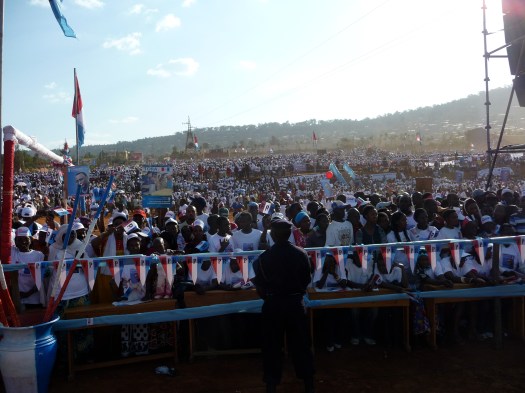
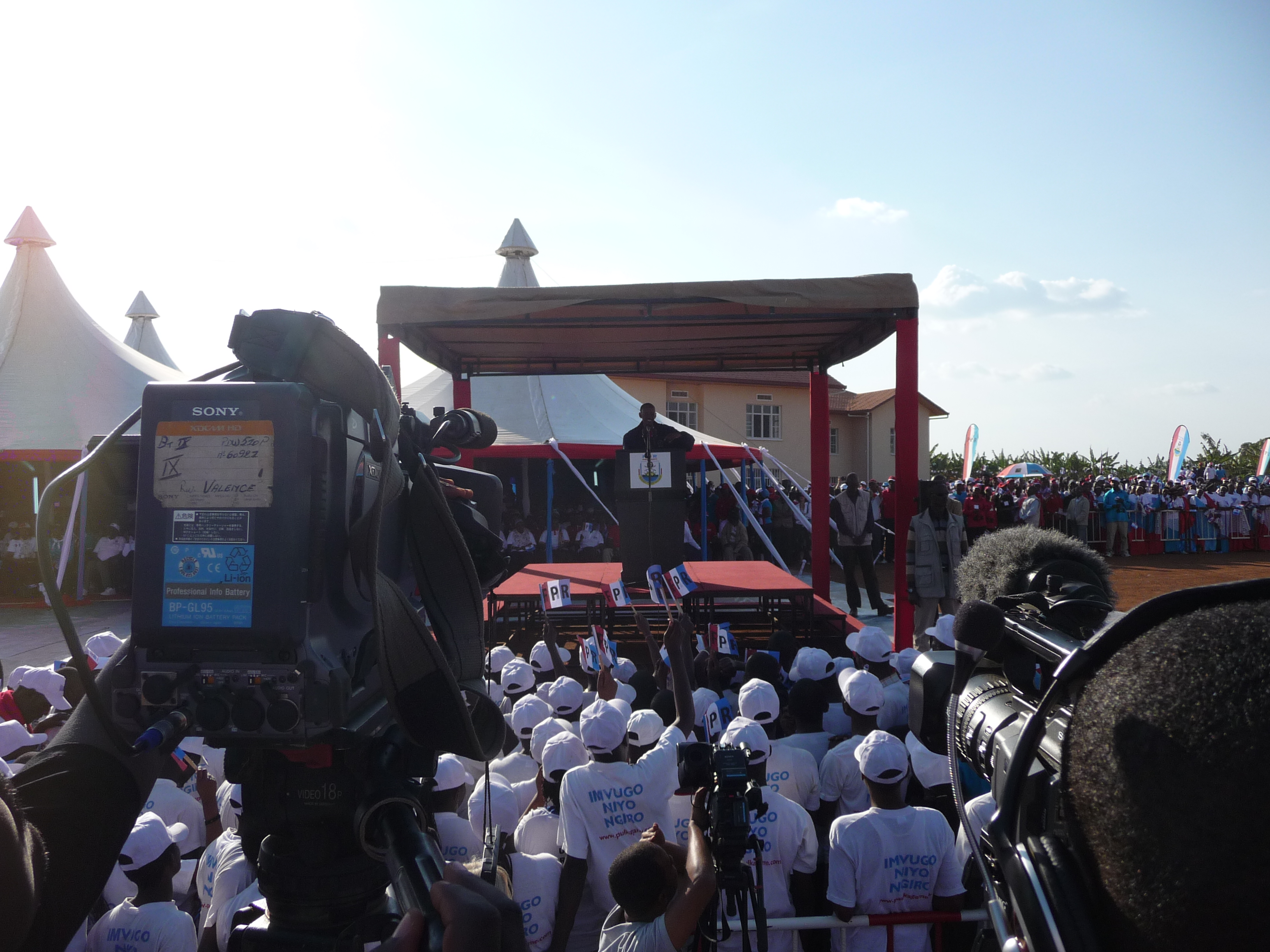
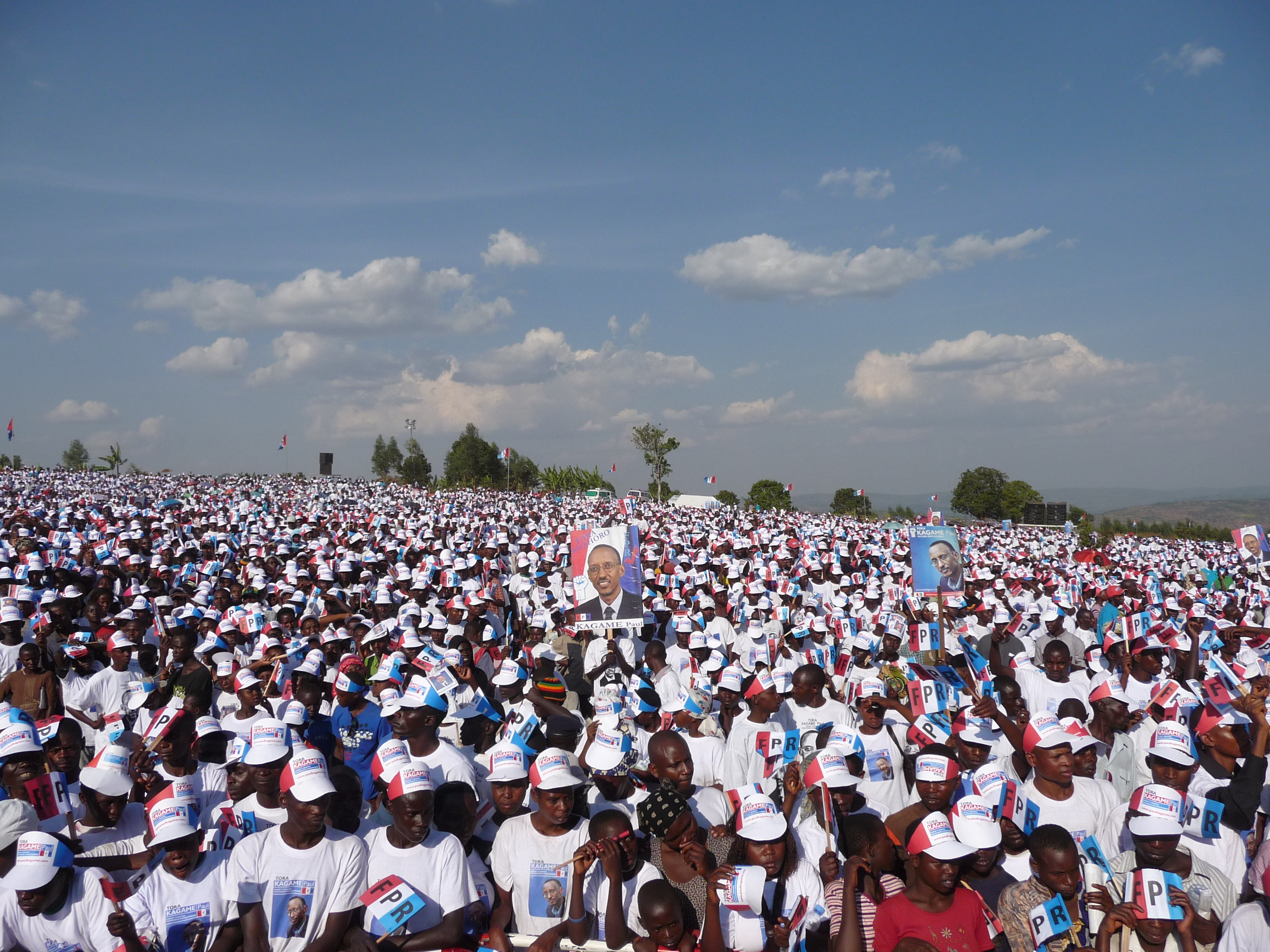
Campaign rally for incumbent president Paul Kagame yesterday in Kigali. Presidential elections will be held on Monday in Rwanda, though the outcome is already quite clear.

Kagame's final rally, August 7, 2010

A young man displays the RPF manifesto on his chest at Saturday's rally