
Endangered books

IMG_2094
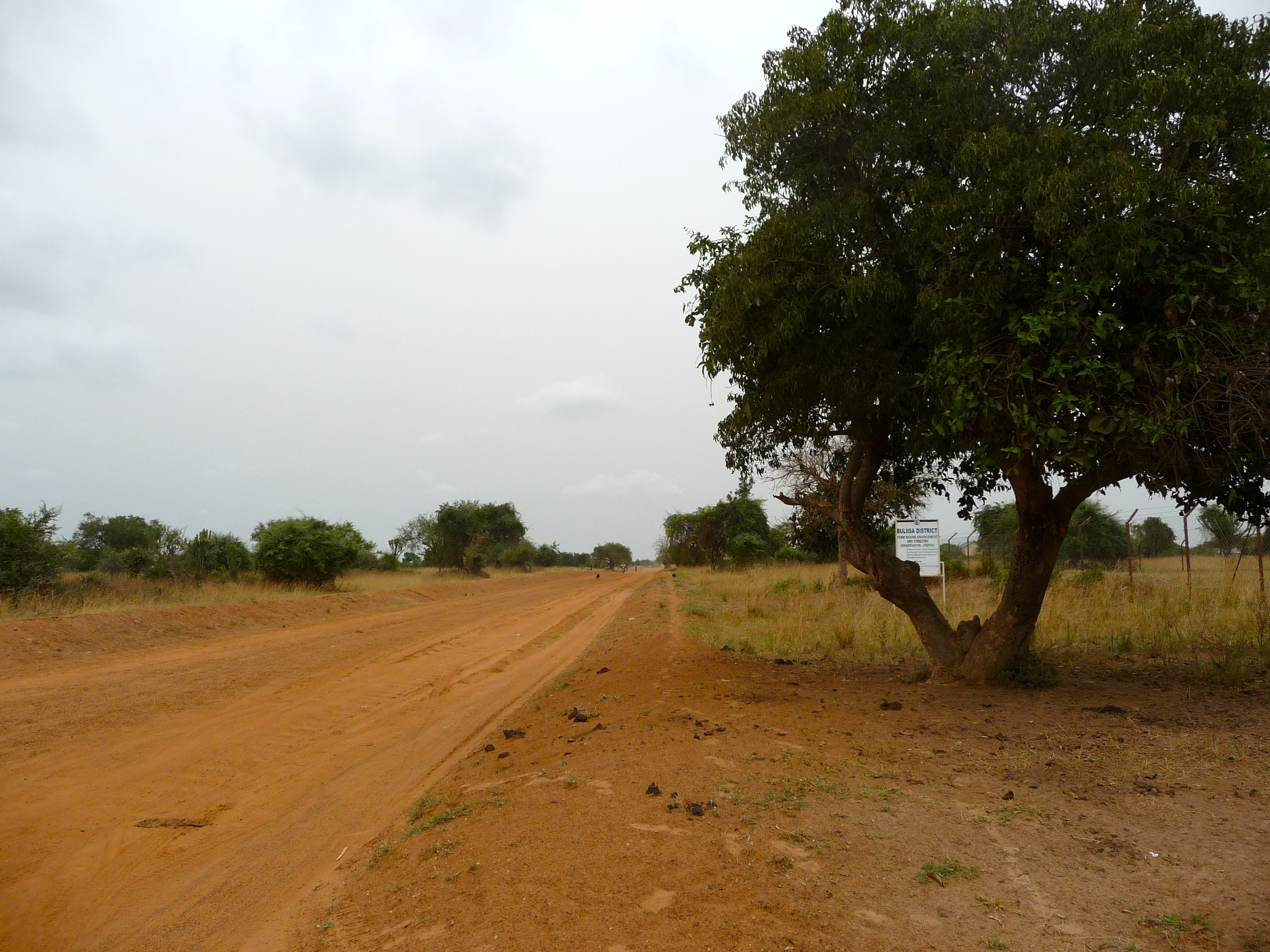
Jinja archives, Jinja, Uganda (2013)

My research of late has explored the responses of Muslim elites and communities to the arrival of missionaries and colonial administrators across Uganda. Sources primarily comprise of missionary accounts, official documents of the colonial administration, manuscripts and books by Ugandan intellectuals and scholars, and work by non-Ugandan anthropologists, most of whom were most active between the 1960s and 1980s.

The best and most detailed accounts tend to be authored by Ugandans, often those who played active roles in shaping the course of the country’s history. Unfortunately, these works are also the most difficult to find. Makerere University Libraries are perhaps the best resource, but you must have university affiliation to use the libraries and you cannot check out or, understandably, copy the books. Thus, many of Uganda’s most precious historical works are quietly locked away from the public.

I’ve identified a class of what I will call “endangered books”. These are books (or theses, etc.) that are now out of print or have never been published, and are virtually impossible to access or acquire without affiliation to a university with a very good library. Many of the authors have passed on, and are not able to lobby for the protection of their hard work. I don’t imagine there is a huge market for many of these books, yet unless steps are taken to republish them, a fire or two is capable of wiping out their existence.

I’m keeping a running list of these works below as I come across them. Hopefully I can convince a publisher to take interest in making sure these treasures do not fall victim to the decay currently facing many archives across Africa (see Jinja archives above). Please feel free to submit your own.

Endangered books:

UGANDA

Y.K. Lubogo. 1960. The History of Busoga. Jinja, Uganda: East Africa Literature Bureau.
Dan Mudoola. 1974. Chiefs and Political Action, The Case of Busoga: 1900-1968. PhD thesis, Makerere University

NIGERIA

Wahab Oladejo Adigun Nasiru. 1977. Islamic Learning Among the Yoruba, 1896-1963. PhD Thesis in the department of Arabic and Islamic Studies, University of Ibadan

Winners and losers in Uganda’s 2013-2014 Budget

BTTB 2013-214

Winners (increased % of budget): Works and Transport, Energy, Public Administration

Losers (decreased total spending): Tourism, Trade and Industry, ICT, Social Development (what is that?), Education

Background to the Budget 2013-2014 available here.

Looks like we are focusing on physical capital at the expense of human capital. Will it pay off?

Health information leads to…cheating!

Well, this is disappointing. A recent study in Uganda supported by Google and the Grameen Foundation, and implemented by Innovations for Poverty Action, has found a way to…increase infidelity.

When provided with information about sexually transmitted diseases via text messaging, cheating among participants more than doubled. Why?

Although the study and its findings have yet to be published, Bloomberg reports:

With the program in Uganda, which began in 2009, infidelity may have risen as women became more aware of the risks of cheating and insisted on going for testing with their husbands, said study author Dean Karlan, an economics professor at Yale University in New Haven, Connecticut. Some men resisted, leading women to deny them sex, which the men then sought from other women, Karlan said.

Basically, it appears that women wanted safer sex, while many men did not.

At first, this struck me as a classic case of unintended consequences, of good intentions paving the proverbial road to hell. However, having finished tearing my hair out (actually, gunning it through Ntinda wondering, what is wrong with these men?!), I realized we have actually learned something important despite the perverse effects of this intervention. Two things, actually. 1) men and women have different preferences regarding safe sex, and 2) women are willing and able to stand up for and protect themselves, at least in Uganda.

Now we need to understand why, faced with the same information as women, men made choices that did not improve their health and did not reduce their risk of contracting a sexually transmitted disease. We also need to find ways to support women to protect themselves and their families.

Looking forward to reading the paper; will update accordingly.

UPDATE: Ungated version of the working paper available here.

Uganda cabinet and army reshuffle — May 24, 2013

The Ugandan government, through the state-owned newspaper, The New Visionannounced President Museveni’s cabinet reshuffle this morning, described as “minor” changes. There are reports of new appointments in the army as well, but these have yet to be published. Is the timing of the reshuffle related to the ongoing tension regarding Gen. David Sejusa’s (aka Tinyefuza) letter? That’s an open question.

Notable changes include:

Gen. Aronda Nyakairima – Minister of Internal Affairs (replacing Hillary Onek)
Ruhakana Rugunda – Minister of Health (replacing Christine Ondoa)
John Nasasira — Minister of ICT (replacing Ruhakana Rugunda)

Other important posts including Prime Minister, Min. of Defence, Education, Energy, Finance, Trade, Foreign Affairs, and Local Government remain unchanged.

Full cabinet list here.

Full permanent secretaries list here.

***************************************************************************************************************

UPDATE: Press release from UPDF spokesman Paddy Ankunda details army reshuffle (New Vision).

PRESS RELEASE

His Excellency the President of the Republic of Uganda and Commander in Chief of  the UPDF has made the following promotions and changes within UPDF.

1.    Gen Aronda Nyakairima formerly the Chief of Defence Forces has been appointed Minister of Internal Affairs.

2.    Lt Gen Edward Katumba Wamala formerly Commander of Land Forces has been promoted to General and appointed the Chief of Defence Forces.

3.    Lt Gen Ivan Koreta formerly Deputy Chief of Defence Forces has been appointed Ambassador of Station to be announced later.

4.    Maj Gen Charles Angina formerly Chief of Staff of Land Forces has been promoted to Lt Gen and appointed Deputy Chief of Defence Forces.

5.    Maj Gen Fred Mugisha formerly the Joint Chief of Staff is appointed Head of the National Counter Terrorism Centre to be set up.

6.    Brig Wilson Mbadi formerly the 4Division Commander is promoted to Maj Gen and appointed Joint Chief of Staff.

7.    Brig David Muhoozi formerly Commander Air Defence Division is promoted to Maj Gen and appointed Commander Land Forces.

8.    Brig Samuel Turyagyenda, Commander Airforce is promoted to Maj Gen.

9.    Brig Leopold Kyanda formerly Chief of Personnel and Administration is appointed Chief of Staff Land Forces.

10.    Col Emmanuel Kanyesigye formerly 5Division Operations Officer transferred to 4Division as Division Commander.

We congratulate the Officers upon their well deserved promotions and appointments and wish them success in their new assignments.

PADDY ANKUNDA psc
Lt Col
DEF/UPDF SPOKESMAN

Angelina Jolie’s choice, our challenge

Today the New York Times published a very personal and, for many people, unexpected op-ed by actress, director, and humanitarian Angelina Jolie. Ms. Jolie, a carrier of the gene BRAC1 with a mutation that significantly increases breast cancer risk, recounts her decision and experience undergoing a preventive double mastectomy — the surgical removal of both of her breasts. There should be no shame in undergoing such a procedure. Still, Ms. Jolie feels compelled to note: “On a personal note, I do not feel any less of a woman.” This is a real concern for many women.

The more we talk about women’s health and the unique health experiences women face, the better. The same goes for men. Our bodies are often imbued with such greater expectations than their basic purpose, to allow us to live our lives. We make judgments about each other based on shape and size, and spend countless, wasted hours making these judgments about ourselves.

I applaud Ms. Jolie for her contribution to this important conversation. It also raises important issues for women’s health beyond the New York Times readership. Ms. Jolie writes,

For any woman reading this, I hope it helps you to know you have options. I want to encourage every woman, especially if you have a family history of breast or ovarian cancer, to seek out the information and medical experts who can help you through this aspect of your life, and to make your own informed choices.

I wish this were more true than it is. For many women around the world, there are not many options. Ms. Jolie is well aware of this, and I believe she will be one among many fighting to change the status quo. In the meantime, there are sobering facts to face at home in Uganda.

  • Breast cancer is the third most common cause of cancer among women in Uganda, behind cervical cancer and Kaposi’s sarcoma (the latter of which are largely preventable).
  • There are two mammography units in Uganda.
  • The vast majority of Ugandan women present at late stages in the cancer’s progression, at which point there is little chance of survival.
  • The estimated budget of the Uganda Cancer Institute is approximately Ushs 5.5 billion, just over US$2 millon (Sector Budget Framework Paper). The State House budget is 36 times that, over Ushs 200 billion.
  • The cost of testing for BRAC1 and BRAC2, as Ms. Jolie notes, is US$3,000 in the United States, and completely inaccessible for almost all women in Uganda.

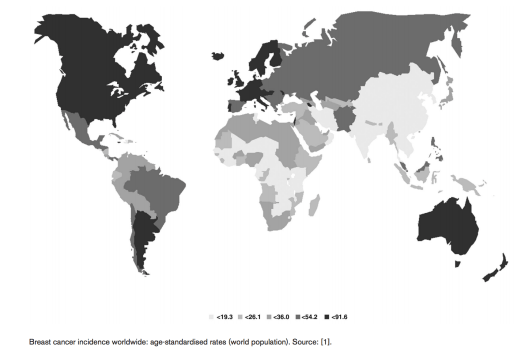
In comparative terms, Uganda has relatively low rates of breast cancer. But it’s hard to know how accurate these figures are due to poor surveillance and diagnosis in much of the developing world.

Citation: Bray, Freddie, Peter McCarron, and D. Maxwell Parkin. "The changing global patterns of female breast cancer incidence and mortality." childhood 4 (2004): 5.
Citation: Bray, Freddie, Peter McCarron, and D. Maxwell Parkin. “The changing global patterns of female breast cancer incidence and mortality.” childhood 4 (2004): 5.

Who supports foreign aid in Uganda?

A new paper by Harris, Milner, Findley, and Nielson finds that while the Ugandan public generally prefers foreign aid to government programs, Ugandan elites (LCs and MPs) prefer government programs:

We examine the differences in behavioral and attitudinal responses between mass and elite recipients. We generally find that citizens strongly prefer foreign aid over government programs, and elites in most contexts express a preference for government programs over foreign aid. The results for masses are stronger than for the elites, but we interpret this as evidence that citizens see aid as an escape from clientelism, whereas elites may perceive more avenues for the capture of aid resources.


Full paper here.

Beautiful Bunyoro

I just returned from a quick tour of Hoima and Buliisa, in the Bunyoro region of western Uganda (now also known as the oil producing region of Uganda…).

Beautiful Hoima district:

P1030325
Hoima Municipality

And Buliisa – located on Lake Albert, tucked in the breathtaking Rift Valley. Commercial development is still lacking, but one imagines this will change in the next few years.

Buliisa District Headquarters (completed in 2008)
Main road through Buliisa, Buliisa Town Council

Uganda: The Health of the Nation

Published online Nov. 4, 2012 in The Independent.

The Health of the Nation
By Melina Platas Izama

Since Uganda hit 50 recently, it seems as good a time as any to check its vitals. There is the heartbeat of the economy and the temperature of the masses, the pressure of the politics and the weight of history. The health of this nation in one word? Resilient.

The Jubilee celebration was not made up of unfettered jubilation, as one might expect at 50 years of independence, but instead doused with a heavy coat of introspection.

The pristine Kampala Road, captured in black and white photos, is hardly recognisable today – a bustling, grating and downright stressful stretch of earth.  Cynics wandered and wondered aloud, are we better off now than we were a half-century ago? Teachers are striking, projects stalling, health clinics leaking staff, money, and drugs. This version of events is familiar. We listen to it every morning and read it every day. Frankly, it’s exhausting.

The health of the nation is in part a function of the health of its people. And here we have some great stories to tell. The greatest story of all is the about the survival of children. In the last fifteen years, death in infants and young children has fallen by nearly 40%. The drop in child deaths was faster in the past five years than it has been in decades.  This is fantastic news.

When Uganda raised her flag for the first time, mothers across the newly birthed state could expect more than one in five of their children to perish before age five and 13% of newborns would not survive their first year. This year, as the flag was raised once more, the death of a child is not foreign, as it should be, but neither does it go hand in hand with motherhood.

The results of the most recent round of the Demographic and Health Surveys (DHS), which have been instrumental in documenting these trends, have just been released for Uganda. Conducted across the country in more than ten thousand households, the DHS has been conducted in 1988, 1995, 2000, 2006 and 2011. While there are a number of improvements to report, the story of child survival, particularly in the last decade, stands out. It is perhaps the greatest achievement of the new millennium in Uganda. Continue reading “Uganda: The Health of the Nation”

Ivory trade in the DRC

Jeffrey Gettleman of the NYT investigates a growing illicit trade in the DRC — not diamonds, gold, or minerals, but ivory. Evidence suggests that military forces in the area, including national armies from DRC, Uganda, and South Sudan, and rebel groups like the Lord’s Resistance Army, have been implicated in the illegal and deadly trade. As much as 70% of all ivory is headed to China. Excerpt below, full article here.

Some of Africa’s most notorious armed groups, including the Lord’s Resistance Army, the Shabab and Darfur’s janjaweed, are hunting down elephants and using the tusks to buy weapons and sustain their mayhem. Organized crime syndicates are linking up with them to move the ivory around the world, exploiting turbulent states, porous borders and corrupt officials from sub-Saharan Africa to China, law enforcement officials say.

But it is not just outlaws cashing in. Members of some of the African armies that the American government trains and supports with millions of taxpayer dollars — like the Ugandan military, the Congolese Army and newly independent South Sudan’s military — have been implicated in poaching elephants and dealing in ivory.

Video: The Ivory Wars

What’s up with West Nile?

West Nile virus, that is. A widespread outbreak in the U.S. has attracted renewed attention to the virus, which acquired its name from West Nile, Uganda, although there is no evidence that it originated there. Unfair, isn’t it? The virus was first isolated in Omogo, West Nile district, Uganda, in 1937, by researchers at the Yellow Fever Research Institute, then based in Entebbe. According to a 1940 article by Smithburn et al. in the American Journal of Tropical Medicine and Hygiene:

In attempting to isolate virus numerous persons were seen who were suffering either from an illness suggesting yellow fever, or from pyrexia of unknown cause. From many such persons blood was drawn, and as soon as possible thereafter the serum was in oculated intracerebrally2 into mice. Subinoculations were done from mice which became ill. In this manner several transmissible infective agents were isolated.

The purpose of this paper is to report the isolation of one such agent, which we call the West Nile virus, and to describe some of its properties. Although this virus was isolated from the blood of a human being, the circumstances of its isolation were such that nothing is known regarding the illness produced by the virus in the human subject.

That the virus was identified in West Nile should, if anything, be a testament to the medical contributions that have been made from the region, but it is more likely to have inspired notoriety. West Nile virus outbreaks have occurred all over the world, but the virus was not identified in North America until 1999.

West Nile virus is carried by mosquitoes, which acquire the virus from infected birds. In rare cases (only about 1 in 150 cases), severe viral infection is characterized by “high fever, headache, neck stiffness, stupor, disorientation, coma, tremors, convulsions, muscle weakness, vision loss, numbness and paralysis“, according to the CDC. Up to 80% of those infected, however, do not experience any symptoms.

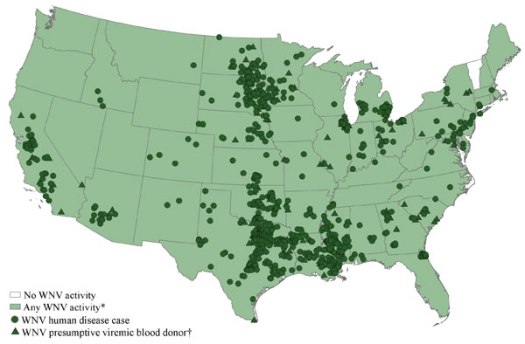
Current map of West Nile activity in the U.S.:

CDC surveillance of West Nile virus in the U.S., activity as of August 21, 2012