
by Edward Echwalu. One of the most talented photographers out there. Check out his year-ender here. Below is the first of his series of stunning photos from 2011. Follow him on Twitter at @echwalu.

by Edward Echwalu. One of the most talented photographers out there. Check out his year-ender here. Below is the first of his series of stunning photos from 2011. Follow him on Twitter at @echwalu.
I am gathering here some opinions regarding Obama’s announcement that 100 U.S. troops will be/have been sent to Uganda to help fight the Lord’s Resistance Army, a rebel group who have been operating for the past several years in the Democratic Republic of Congo, the Central African Republic, and South Sudan and in northern Uganda before that. There seems to be a dearth of good analysis on this topic (I realize the news just came out yesterday), but I will try to add more as they become available/are brought to my attention. Anyone have any additions?
US deploys special forces in Uganda, but why? Angelo Izama
Obama’s troops in Central Africa to fight LRA; will they deliver? Rosebell Kagumire
Did Obama make the right call on Kony? James Lindsay
And here is a very neat link to the US cables mentioning the LRA. It’s interesting that there were practically no cables on the LRA before 2006, despite the fact that the group was most active in Uganda from the 1990s to around 2005. (h/t Washington Post*)
*I should note, however, that in general I feel this post doesn’t really capture the politics or even essence of the LRA.
A new one not to be missed: Rush Limbaugh “Obama invades Uganda, targets Christians“. Foreign Policy post on Limbaugh’s blindly ideological and shockingly uninformed statements here.
NYT article here. US has provided $33 million in the region to fight the LRA since 2008.
The game yesterday didn’t go well, but it’s Uganda’s Independence Day today, so let’s celebrate anyway. Happy 49th.
I want to devote some upcoming posts to discussing where Uganda has come since 1962, and what lies ahead. Many today hold a dreary outlook for the country both politically and economically, especially in light of where they imagined Uganda might be nearly 50 years after Independence. While I am confident there will be major bumps in the road ahead (I think it is safe to say we are in smack in the middle of one at the moment), unmitigated pessimism is unwarranted, and ultimately, self-defeating.
Between disappointments, mistakes, and even despicable actions by some of those who shall remain nameless for now, there are equally many hopes, dreams, innovations, and breakthroughs made by ordinary citizens, entrepreneurs, and leaders alike. Perhaps the most amazing is seeing people come together to demand policies that serve the interests of the public, or whose support of a team converts them, however briefly, from individuals into a nation. Occasionally the goal is missed, but the spirit remains. It is this spirit, for lack of a better word, that will make the difference — little by little, day by day.
And so, today we celebrate another such day. One where disappoints are squarely and painfully faced, but also where millions of small steps are made, many in the right direction.
Happy Independence Day, Uganda.
Call these guys. Spotted in a prominent Ugandan government office, where the lifts stop on a programmed set of floors. Don’t get in the wrong one, otherwise you’ll have the accidental pleasure of elevator surfing. And they don’t move that fast. Unfortunately I have recently been in multiple such government office buildings, so this description is not even a give-away.
In other news, Uganda Cranes oye! We go, we go, Uganda Cranes we go, WE GO!
Best of luck tomorrow, and everyone stay safe!
P.S. Looking forward to your photos @echwaluedward!
Time to make the trek across the globe that is. Entebbe-San Francisco, via Addis and Dubai. I’m getting back just in time for classes to begin on Monday, and looking forward to TAing for a new crop of students in Democracy, Development, and the Rule of Law, taught by Larry Diamond and Kathryn Stoner-Weiss.
In other news?
I can now no longer put off packing, so that’s all for now.
I’ll see if I can get some wi-fi in Dubai. Otherwise, I’ll see you on the other side.
UPDATE:
I know, you thought I was packing. So did I. But I just read that the Uganda Shilling has fallen to an 18-year low – Ushs2901 to the dollar, according to Reuters. Annnnnd, the power just went out. Tough times indeed.
Well, after 24 hours of the worst flu I’ve had since childhood, I’m back. There is a serious virus(es?) going around this town (Kampala that is); several people are reporting symptoms on twitter and a number of friends have been taken ill. Wash those hands! The good news is the worst symptoms (namely, high fever with the usual chills and aches) seem short-lived. But that’s not much comfort when you’re in the middle of the thing.
Anywayyyy… what I really wanted to share is an email I got from TripAdvisor after reviewing Endiro (coffee shop in Kisementi) online. After I wrote a post on Uganda’s online tourism presence, I decided I should do my part in sharing information online about the places I frequent. Ideally, there should be a forum other than TripAdvisor to do this, but I had a feeling more people would read reviews on that popular platform than elsewhere. It might be useful for the managers/owners of the restaurants/hotels/etc. to see what others are saying about them online as well (the second review of Endiro, for example, is rather scathing).
Yesterday, I got this email from TripAdvisor:
 What I found most interesting, of course, was that there were “3,105 travelers looking for information about Kampala this week”.
I don’t know how they calculate the number of “travelers” (as opposed to clicks on Kampala-related sites on their page) but at least this gives us a clue as to how many people are seeking information about Uganda online. First of all, this figure is only for Kampala, and second of all, it is only for TripAdvisor, suggesting that the number of folks looking for information online on Uganda is in the multiple thousands every week.
I had not previously found data regarding online searches for Uganda tourism, but this at least gives us a rough idea, and provides further evidence that Uganda’s online tourism presence matters! Over to you, UTB.
On a related note, Bernard Tabaire (@btabaire) has an interesting column on Uganda’s tourism sector in last Sunday’s Daily Monitor, link here.
As my partner-in-crime was felled by a fever this weekend, I got to wondering how often people treat themselves for malaria when they really have a nasty virus, flu or otherwise. If you don’t have the time, resources, or energy, it might seem like a good idea to pop some anti-malarials (assuming you can get them) just in case.
I gave a presentation about health services and malaria in Uganda several weeks ago, in which, among other things, I bemoaned the lack of attention malaria receives from government. Browsing various publications, studies, and policy reports, I mentioned several stats, including the following:
One of the audience members asked about the accuracy of reporting of malaria cases in Uganda. While malaria is undeniably one of the most important health challenges Uganda faces, it is important to acknowledge that the capacity to diagnose malaria is generally weak, and many if not most of the malaria cases and deaths are not laboratory confirmed. There is probably a sizable chunk of these “malaria cases” that are not actually malaria, but rather a flu or some other virus or infection.
The 2009 Malaria Indicator Survey found that of the 3,727 children included in the survey, 44.7% were reported to have had a fever in the preceding two weeks. While 70% of children with fever were taken to a health facility or health provider, only 17% were reported as having been tested for malaria through a finger or heel prick. 60% of children with fever ended up taking anti-malarials, and 15% took antibiotics.
I’m still astounded that 42% of the children in the survey tested positive for malaria (62% were anemic). This figure is especially high when you compare it with other countries in the East African region (see above). Prevalence varies quite a bit by region as well.
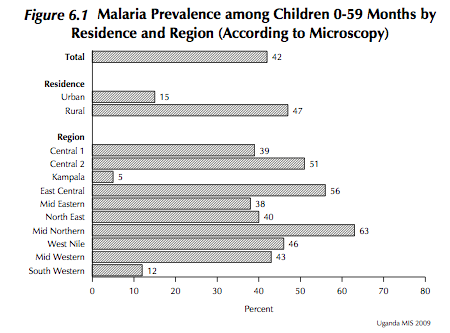 Source: Uganda Malaria Indicator Survey 2009, page 61.
The internet has slowed to a crawl, but I’ll post some more links on this soon.
In Uganda it seems like everyone and their mother (I do mean that literally) has their own business. In fact, the 2010 Global Entrepreneurship Monitor Report on Uganda finds that 31 of every 100 working age Ugandans are involved in some kind of entrepreneurial activity, making Uganda the 6th highest in terms of entrepreneurship out of the 59 countries surveyed.
Interestingly, there appears to be a strong relationship between GDP per capita and entrepreneurial activity, as can be seen below.
 Source: 2010 GEM Uganda report, page 32. Download here.
So what does this mean?
High TEAs [Early Stage Entrepreneurial Activity] are mainly registered in developing countries. And there’s a group of scholars that have argued that the greater the poverty, the higher the TEA of the country concerned. GEM Uganda team does not wholly agree with these scholars as its number of entrepreneurs motivated by opportunity is also high and so is that of Ghana, Zambia and Angola.
Although the team believes that necessity is a factor in Uganda’s high TEA, some entrepreneurs are keen to pursue business opportunities in the country. The positive relationship between economic growth and entrepreneurship is unquestioned; it is the causality, the measures used, and the role of the state that need to be explored further.
I’m curious about the relationship between the Doing Business scores and entrepreneurship as well. I would imagine that while it may be difficult to set up a business formally (i.e. following all the rules/wading through bureaucracy) in countries like Uganda, the relative lack of regulation encourages entrepreneurs to try their luck in business, especially in the informal sector.
Your thoughts?
Today marks the inaugural post of a new series, cleverly titled “cows“. Featured here are the cows of Kampala and beyond, just going about their business.
Cow-of-the-day: Norman of Naalya, 10:45am

Have your own cow photos? Send them along!
Around 75% of all visitors to Uganda come from another African country (especially East Africa), and the remainder are Europeans (13%), Americans (6%), and Asians (4%)*.
The increase in visitors in recent years appears to driven mainly by an increase in visitors from the East African region, while the numbers of those from Europe, America, and elsewhere has stayed more or less the same. Approximately 60% of visitors arrive by road, while the other 40% arrive by air.
Visitors to Uganda by region and year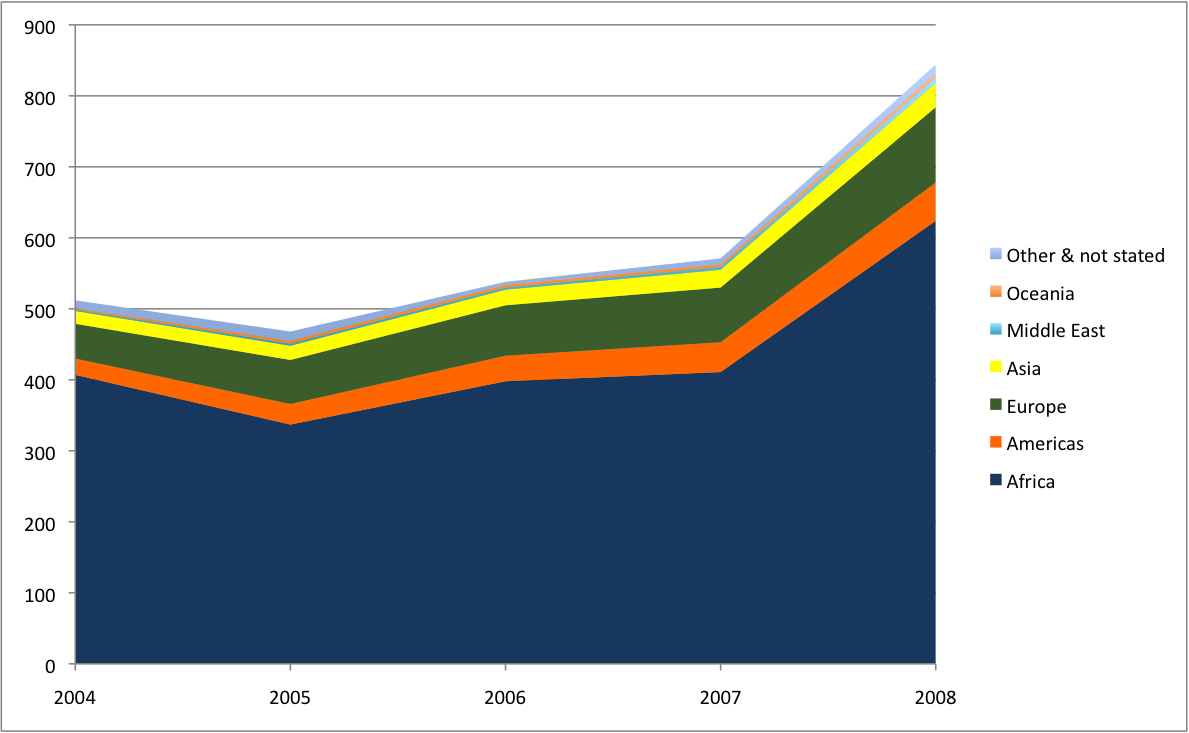
How many of these visitors are tourists?
Of the 840,000 visitors registered in 2008, only 144,000 listed “Leisure, recreation and holidays” as the primary reason for visiting, suggesting that tourists make up a relatively small portion of the visitors the the country. The number of visitors who go to national parks, around 138,000 in 2008, is also fairly good proxy for the number of those who are “tourists”, as opposed to those who are visiting family and friends, doing business, and the like.
For perspective, over 1 million tourists visited Kenya in 2009, and over 700,000 visited Tanzania (2009), and 68,000 holiday-goers visited Rwanda (2010).
Visitors to national parks in Uganda, by year
 In Uganda, Queen Elizabeth and Murchison are by far the most popular game parks, and we should probably expect more interest in Murchison in the coming years now that the LRA no longer poses a threat in northern Uganda.
The Uganda Bureau of Statistics estimates that tourism expenditure was US$590 million in 2008. This year, the Ministry for Tourism, Trade and Industry was allocated Ush50 billion, or about US$18 million, which amounts to 0.5% of the total budget. The Uganda Tourism Board was allocated US$740,000.
*Statistics above can be found on the UBOS website here. Budget information can be found in the 2011/2012 Background to the Budget, available here. I used an exchange rate of Ushs2700 to the dollar for back-of-the-envelope calculations.
 Melina Raquel Platas