be inspired

There’s not much new I can say here, but I will try. I feel great sadness for the loss of a truly inspirational man, who has changed the world forever. I wish he could see the outpouring of love, support, and gratitude from tens of millions of people all over the world. I wish for peace and comfort for his family in this most difficult time.

I have passed by his home countless times, which is a short distance from my own, but I never met Steve Jobs. Growing up in Palo Alto, I remember as a child I took a field trip to an Apple office in the early 1990s, where we got stickers in the shape of the company’s trademark logo. My first computer was a clunky Macintosh desktop, which I loved.

Today it is hard to quantify the way in which Jobs’ ideas have changed the way we work and the way we live, across the globe. I think the most important thing we can learn from his life has nothing to do with the products he helped create, but the way in which he created them. In his 2005 Stanford commencement speech, he urged us to dream big, and to follow our hearts, even when it leads us off the well-worn path. That will make all the difference.

“…the people who are crazy enough to think they can change the world, are the ones who do.”

To a man who continues to inspire and change the world, thank you.

books on my reading list

At the beginning of every school year I am invariably overly ambitious about what I can realistically accomplish, including the number of books that can reasonably be read in a day week. Nevertheless, let me begin a list here of the books I hope to tackle (required reading not included) in the next couple of months.

  • The Escape from Hunger and Premature Death, 1700-2100, by Robert Fogel.                                                                                                                       “Technophysio evolution and its implications are the central themes of this volume. The term describes the complex interaction between advances in the technology of production and improvements in human physiology. The interaction is synergistic, which means that the total effect is greater than the sum of its parts. This interaction between technological and physiological improvements has produced a form of evolution that is not only unique to humankind but unique among the 7,000 or so generations of human beings who have inhabited the earth.” This book sounds remarkably like the dissertation I hope to write. Only that I almost surely will never win a Nobel Prize in economics …details, details.
  • African Development: Making Sense of the Issues and Actors, by Todd J. Moss (@moss_dc)                                                                                                  “This book aims for a simple, but hopefully not simplistic, introduction to the main themes, trends, and players in contemporary African development.” This book seems to be doing the rounds in development circles and is probably a good resource for both teachers and students of African politics and development.
  • The Drunkard’s Walk: How Randomness Rules Our Lives, by Leonard Mlodinow                                                                                                               “Offering readers not only a tour of randomness, chance and probability but also a new way of looking at the world, this original, unexpected journey reminds us that much in our lives is about as predictable as the steps of a stumbling man fresh from a night at the bar.” Recommended by a brilliant and enterprising friend whose reading recommendations can only be totally worthwhile. And it has a great title!
  • Decentralization in Uganda: Explaining Successes and Failures in Local Governance, by Gina M.S. Lambright.                                                                  Just discovered this one in a political science “new books” publication.
  • Museveni’s Uganda: Paradoxes of Power in a Hybrid Regime, by Aili Tripp       Also recently discovered this one, has anyone read it?
  • Decision Points, George W. Bush                                                                        Because political autobiographies are fascinating.

More to be added as we go along. What are you reading?

UPDATE:

See, I’m already getting ahead of myself. So far I have read 1.1 of the above books (specifically Fogel, and a bit of Bush and Moss), and I’ve already added more. Recent additions:

I also recently read Rational Ritual: Culture, Coordination and Common Knowledge, by Michael Suk-Young Chwe, which I recommend and hope to write about soon.

hotels: the tragedy of….

Sorry for the extremely sparse posting this week. I’m still trying to get my bearings on this side of the world.

I’ve written recently about writing reviews online for hotels, restaurants, etc., and in general the importance of an online tourism presence. Of course the quality of the posts matters though….

Hat tip @jchaskell24.

Now I’m off to celebrate the most amazing woman in my life. Happy birthday mama! You’re the best.

Does results-based financing in health work?

I’ve been reading “An overview of research on the effects of results-based financing,” published by the Norwegian Knowledge Centre for Health Services, which discusses ten reviews of RBF schemes in low and middle-income countries (LMIC). What did they find?

  • “Conditional cash transfer (CCT) programmes have been found to be effective at increasing the uptake of some preventive services which were already free.”
  • “The success of CCT depends on the existence of effective primary health services and local infrastructures.”
  • “Although financial incentives are considered to be an important element of strategies to change professional practice, there are relatively few well-designed studies and overall the evidence is weak.
  • “A small number of more rigorous evaluations have examined relatively simple preventive interventions, such as the impact on rates of immunizations and screenings, as opposed to more complex interventions. The success of a financial incentive is likely to be inversely related to the complexity of the tasks it seeks to motivate.”

Overall, it appears the quality of evaluation of RBF schemes has been relatively poor. The available evidence suggests we need to look more carefully at the (perhaps very specific) conditions under which RBF can work. I’m afraid RBF might not work well in the public sector in the absence of fairly strong government support and political commitment to the project. But that is something to be explored…

inspiration: Kennedy and Maathai

As I finished reading Ted Kennedy‘s True Compass in the early hours of the morning, I also poured over the hundreds of tweets and articles about the passing of the Kenyan environmentalist and Nobel Peace Prize winner, Wangari Maathai. Both battled cancer, and both, through their life’s work and struggle, have provided inspiration to millions. As a new day, a new week, and a new quarter begins, I want to keep in mind some of the lessons, hopes, and challenges they have shared.

This is the greatest lesson a child can learn. It is the greatest lesson anyone can learn. It is the greatest lesson I have learned: if you persevere, stick with it, work at it, you have a real opportunity to achieve something. Sure, there will be storms along the way. And you might not reach your goal right away. But if you do your best and keep a true compass, you’ll get there.

Edward M. Kennedy, True Compass


The revolution I propose requires the development of policies that work for the benefit of all citizens rather than the advantage of a few. It necessitates standing up to international interests that seek access to the considerable natural resources with which Africa is blessed for less than their fair market value. It entails implementing decisions that encourage the dynamism and entrepreneurship of African peoples, protecting them from unfair competition, and nurturing economies that add value to the commodities that the rest of the world desires so much…Perhaps the most important quality that the African leadership needs to embrace, and which is desperately lacking across the continent, is a sense of service to their people.

Wangari Maathai, The Challenge for Africa


palo alto baby

In my dazed and jet-lagged stupor yesterday afternoon, I flipped through a recent issue of Vanity Fair in a desperate attempt to stay awake until a bedtime-worthy hour. They had a fun little graphic of my hometown, replete with the silicon valley hotspots (the online version has a full list). Somehow they forgot my house. And Alpine Inn!

What would you add?

it’s about that time again

Time to make the trek across the globe that is. Entebbe-San Francisco, via Addis and Dubai. I’m getting back just in time for classes to begin on Monday, and looking forward to TAing for a new crop of students in Democracy, Development, and the Rule of Law, taught by Larry Diamond and Kathryn Stoner-Weiss.

In other news?

  • Opposition leader Michael Sata wins the presidency in Zambia. My good friend and fellow grad student Ken Opalo was in Zambia this week and has been writing about the election here. He suggests following @LoiusRedvers for updates.
  • Some snooping around suggests the flu that is still harassing me is quite widespread around Kampala. Friends who have gone to the Surgery and IHK with symptoms said they were told there is a severe strain going around. Perhaps it has peaked by now, but I wonder if the Ministry of Health shouldn’t have put out some kind of message. A fever that jumps from normal to 102 F (with ibuprofen!) in a matter of hours is no joke, especially for young kids and the elderly. Ok, end rant.
  • For those of you in the Bay Area, Stanford Professor Beatriz Magaloni and several others are organizing a conference on violence in Mexico: “Violence, Drugs, and Governance: Mexican Security in Comparative Perspective.” Speakers include Steve Krasner, Francis Fukuyama, David Kennedy, Karl Eikenberry, and many more. Not to be missed!
  • Another conference to put on the calendar is “Redefining Security Along the Food/Health Nexus,” hosted by Stanford’s Freeman Spogli Institute. Keynote speakers include Kofi Annan and Robert Gates.

I can now no longer put off packing, so that’s all for now.

I’ll see if I can get some wi-fi in Dubai. Otherwise, I’ll see you on the other side.

UPDATE:

I know, you thought I was packing. So did I. But I just read that the Uganda Shilling has fallen to an 18-year low – Ushs2901 to the dollar, according to Reuters. Annnnnd, the power just went out. Tough times indeed.

review this: Kampala online

Well, after 24 hours of the worst flu I’ve had since childhood, I’m back. There is a serious virus(es?) going around this town (Kampala that is); several people are reporting symptoms on twitter and a number of friends have been taken ill. Wash those hands! The good news is the worst symptoms (namely, high fever with the usual chills and aches) seem short-lived. But that’s not much comfort when you’re in the middle of the thing.

Anywayyyy… what I really wanted to share is an email I got from TripAdvisor after reviewing Endiro (coffee shop in Kisementi) online. After I wrote a post on Uganda’s online tourism presence, I decided I should do my part in sharing information online about the places I frequent. Ideally, there should be a forum other than TripAdvisor to do this, but I had a feeling more people would read reviews on that popular platform than elsewhere. It might be useful for the managers/owners of the restaurants/hotels/etc. to see what others are saying about them online as well (the second review of Endiro, for example, is rather scathing).

Yesterday, I got this email from TripAdvisor:

What I found most interesting, of course, was that there were “3,105 travelers looking for information about Kampala this week”.

I don’t know how they calculate the number of “travelers” (as opposed to clicks on Kampala-related sites on their page) but at least this gives us a clue as to how many people are seeking information about Uganda online. First of all, this figure is only for Kampala, and second of all, it is only for TripAdvisor, suggesting that the number of folks looking for information online on Uganda is in the multiple thousands every week.

I had not previously found data regarding online searches for Uganda tourism, but this at least gives us a rough idea, and provides further evidence that Uganda’s online tourism presence matters! Over to you, UTB.

On a related note, Bernard Tabaire (@btabaire) has an interesting column on Uganda’s tourism sector in last Sunday’s Daily Monitor, link here.

felled by fever

As my partner-in-crime was felled by a fever this weekend, I got to wondering how often people treat themselves for malaria when they really have a nasty virus, flu or otherwise. If you don’t have the time, resources, or energy, it might seem like a good idea to pop some anti-malarials (assuming you can get them) just in case.

I gave a presentation about health services and malaria in Uganda several weeks ago, in which, among other things, I bemoaned the lack of attention malaria receives from government. Browsing various publications, studies, and policy reports, I mentioned several stats, including the following:

  • Malaria is the cause of 32% of child deaths in Uganda (DHS Child Verbal Autopsy 2007)
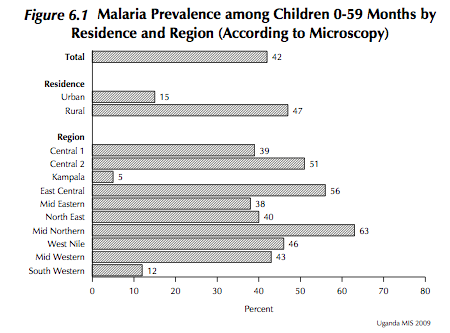
  • 42% of children tested positive for malaria during the DHS Malaria Indicator Survey 2009 , compared to 0.7% in Ethiopia, 2.6% in Rwanda, 7.6% in Kenya, and 18% in Tanzania.
  • Malaria is responsible for 30-50% of all outpatient visits, 15-20% of all admissions, and 9-14% of all inpatient deaths
  • Uganda ranks third in the world in terms of malaria deaths

One of the audience members asked about the accuracy of reporting of malaria cases in Uganda. While malaria is undeniably one of the most important health challenges Uganda faces, it is important to acknowledge that the capacity to diagnose malaria is generally weak, and many if not most of the malaria cases and deaths are not laboratory confirmed. There is probably a sizable chunk of these “malaria cases” that are not actually malaria, but rather a flu or some other virus or infection.

The 2009 Malaria Indicator Survey found that of the 3,727 children included in the survey, 44.7% were reported to have had a fever in the preceding two weeks. While 70% of children with fever were taken to a health facility or health provider, only 17% were reported as having been tested for malaria through a finger or heel prick. 60% of children with fever ended up taking anti-malarials, and 15% took antibiotics.

I’m still astounded that 42% of the children in the survey tested positive for malaria (62% were anemic). This figure is especially high when you compare it with other countries in the East African region (see above). Prevalence varies quite a bit by region as well.

Source: Uganda Malaria Indicator Survey 2009, page 61.

The internet has slowed to a crawl, but I’ll post some more links on this soon.

Uganda’s entrepreneurs

In Uganda it seems like everyone and their mother (I do mean that literally) has their own business. In fact, the 2010 Global Entrepreneurship Monitor Report on Uganda finds that 31 of every 100 working age Ugandans are involved in some kind of entrepreneurial activity, making Uganda the 6th highest in terms of entrepreneurship out of the 59 countries surveyed.

Interestingly, there appears to be a strong relationship between GDP per capita and entrepreneurial activity, as can be seen below.

Source: 2010 GEM Uganda report, page 32. Download here.

So what does this mean?

High TEAs [Early Stage Entrepreneurial Activity] are mainly registered in developing countries. And there’s a group of scholars that have argued that the greater the poverty, the higher the TEA of the country concerned. GEM Uganda team does not wholly agree with these scholars as its number of entrepreneurs motivated by opportunity is also high and so is that of Ghana, Zambia and Angola.

Although the team believes that necessity is a factor in Uganda’s high TEA, some entrepreneurs are keen to pursue business opportunities in the country. The positive relationship between economic growth and entrepreneurship is unquestioned; it is the causality, the measures used, and the role of the state that need to be explored further.

I’m curious about the relationship between the Doing Business scores and entrepreneurship as well. I would imagine that while it may be difficult to set up a business formally (i.e. following all the rules/wading through bureaucracy) in countries like Uganda, the relative lack of regulation encourages entrepreneurs to try their luck in business, especially in the informal sector.

Your thoughts?