McCain’s Worst Ideas — Gag me


Foreign Policy magazine has recently published what they consider to be each of the presidential nominees’ 10 worst policy ideas. Among them was McCain’s support of the Global Gag Rule (excerpt from the FP article below).

Supporting Abstinence-Only Education and the Global Gag Rule

What he said: Asked on the campaign trail if he thought grants for sex education should include instruction on contraception, McCain turned to an aide for help, saying, “Brian, would you find out what my position is on contraception—I’m sure I’m opposed to government spending on it, I’m sure I support the president’s policies on it.” The reporter asked, “Do you think contraceptives help stop the spread of HIV?” After a long pause, McCain replied, “You’ve stumped me.” Town hall meeting, Iowa, Mar. 16, 2007

Why it’s a bad idea: A landmark, 10-year study sponsored by Congress found in 2007 that students in sexual-abstinence programs “were just as likely to have sex as those who did not, reported having similar numbers of sexual partners, and first had sex at about the same age,” the Chicago Tribune reported. Abstinence-only education is one of the core principles guiding the so-called global gag rule, an executive order passed by President George W. Bush in 2001 that prohibits giving foreign aid to NGOs that offer any kind of counseling on abortion as family planning. McCain voted against repealing the measure in 2005. Critics of the gag rule point to reports showing a shortage of contraceptives, clinic closings, loss of funds for HIV/AIDS education, and a rise in unsafe abortions since it was instituted.

Now, I have many issues with foreign aid and the global aid industry, including bilateral donors like the US, and am highly skeptical of the effectiveness of the President’s Emergency Fund for AIDS Relief (PEPFAR). HIV/AIDS has become an obsession of the aid community and has hijacked or otherwise derailed domestic health priorities. While the global gag rule should not be the biggest of our concerns regarding foreign aid, it just goes to show you the hubris of aid policy makers. Abortion is illegal in Uganda — but whether or not NGOs in the country offer any kind of counseling on abortion should be the concern of Ugandans, not Americans who have themselves legalized the practice.

I am not at all confident Barack Obama will help make critical changes to the aid industry — there has been little evidence that he is thinking differently about foreign aid than his party typically has. But I am certain that a President McCain would make the same self-righteous and arrogant blunders as his predecessor. Which experience shows will do little to help those on the receiving end of aid, and which will burn a lot of taxpayers’ dollars on the way.

Leeza in Libya


I wonder how uncomfortable Condoleeza Rice felt during her recent visit with Col. Muammar Gaddafi or what either gained from the interaction. Well, we know she gained a locket engraved with his picture, according to the New York Times. And we know Gaddafi gained an intimate one-on-one (plus translators and note-takers) with the woman whom he strangely referred to as “my darling black African woman,” and of whom he said, “Leeza, Leeza, Leeza…I love her very much,” according to another Times article.

Why shower the woman with such affection? Perhaps in hopes that it would continue the mending of the US-Libya relationship? I get the sneaking suspicion however, that he doesn’t take her fully seriously as a professional. In the public spotlight Ms. Rice must of course graciously receive Gaddafi’s rather narcissistic gifts. But all the while she must be thinking, who does this guy think he is? I know I would.

I have seen his motorcade and entourage take on Kampala, posters of his face plastered all over the city. He came and belittled the Bible and mocked Christianity, in a country where the majority of people are Christian. The guy has one of the biggest egos around, and let me tell you, that is saying something. It would have been the cause of a clash with Museveni….but of course there is nothing that a little (ok, a lot) of money and investments can’t smooth over. Oh yeah, and he also suggested to Museveni that he should never leave power…

Rethinking Aid

For all the noise the Jeffrey Sachses of this world have made about not giving enough money to the poor, the fact is that many poor countries are being crushed under the weight of foreign aid. I recently had a conversation with an economist in Kampala working for a government that gives a lot of money to Uganda each year. Frustrated only begins to describe how this government official felt about the impact of foreign aid in Uganda. Fundamental questions are never even considered by many donors — questions like, should we intervene in the first place? Are we first doing no harm? And perhaps most importantly, who cares? Because if local civil servants and politicians don’t care about your project, you will go nowhere fast, and burn a lot of taxpayers’ money on the way.

A conference took place this week to discuss some of these issues in Accra, Ghana. Read more about it in this article by the Economist.

Levy Who?

This is my take on the death of Zambian president Levy Mwanawasa (published in a recent issue of The Independent). The Economist also had a interesting obituary.

Those familiar with the health of Levy Mwanawasa, late President of Zambia, may be saddened but not surprised by his recent death at the relatively young age of 59. He has been in a fragile state since the automobile accident in 1991 that nearly killed him, suffered a first stroke just prior to Zambia’s 2006 presidential elections and then suffered a second and final stroke on the eve of the African Union summit, held this June in Sharm al-Sheik. Though he has been in treatment since June, he never recovered, and passed away in a Parisian hospital on the morning of August 19, 2008.

His death may not come as a shock to those who follow news in the African community, but much of the rest of the world may be asking, Levy who? President of what? That is if they even hear word that the Zambian president has died. Most would struggle just to locate Zambia on a map.

President Mwanawasa never held the limelight in the way that so many African leaders have, including Robert Mugabe, Thabo Mbeki, Omar al-Bashir, Mwai Kibaki, Nelson Mandela, Mobutu Sese Seko, Kwame Nkrumah – the list goes on and on. Some of these men became famous, or rather infamous, for the sheer scale of corruption, incompetence, or violence over which they presided or directed. Others were revolutionaries in their own right, involved in historic struggles signifying the triumph over colonialism.

There are few African leaders that have taken the spotlight for their good leadership or commitment to democracy, Nelson Mandela being the major exception. At least, there have not been many who have taken this spotlight for long. In recent years, a string of leaders on the continent have been hailed as part of the “new breed of African leader,” including our own President Museveni. Others that have been included in this category at one time or another include Ethiopia’s Meles Zenawi, Kenya’s Mwai Kibaki, and Ghana’s Jerry Rawlings. Yet surely and steadily all of these leaders fell out of favor with many of their own people and the international community at large.

Their fame however, did not reach its true heights for the successes of their early years in power (at least outside of the aid community) but rather for their sometimes spectacular slides into corruption and chaos. Perversely, their tendencies toward authoritarianism have actually brought them more fame than any of them ever had as part of the “new breed.” Kibaki did not become a household name outside of East Africa, for example, until the world watched in horror and shock as Kenya slipped into a violent chaos in early 2008 following the contested presidential elections. Even Rwandan President Paul Kagame is better known worldwide as an autocrat who has violently squelched opposition than for the truly remarkable transformation Rwanda has made under his rule. So it is not particularly surprising that Mwanawasa has slipped under the radar until his untimely death this month.

But towards the end of his presidency, the late Zambian President was beginning to make waves and perhaps could have begun to make an international name for himself. He successfully removed the immunity that had been protecting former Zambian president Frederick Chiluba from facing prosecution for corruption charges, and Mwanawasa was one of the few African leaders who did not mince words over Mugaba’s reign of terror (or at least terrible policy). In 2007 he accused Mugabe of turning his country into a “sinking Titanic” and this year described the results of the flawed Zimbabwean presidential election as “scandalous.” He seemed unafraid to step on the toes of those he caught with their hands in the cookie jar – or ballot box for that matter. Thus, Mwanawasa’s life was cut short just when he seemed on the verge of becoming part of the “new breed.” Would he have continued along this path or fallen to the doldrums of autocracy like so many who went before him? And was he as good a leader as his obituaries and eulogies now make him out to be?

At the beginning of his presidency, he was considered by many to be dull and slow. Not unlike U.S. president George W. Bush, though perhaps less notoriously, Mwanawasa had a tendency to blunder in public speaking, at one point even calling Chiluba “my elder sister.” He soon overcame this perception and the title “the Cabbage” that he had earned, becoming a formidable force against those he believed to be corrupt. Chiluba thought the scratch-my-back-and-I’ll-scratch-yours approach would work with Mwanawasa, but he was in for a nasty surprise.

Through Mwanawasa was handpicked for the presidency by Chiluba in 2001, he felt no obligation to protect his predecessor from facing the consequences of his crooked dealings while in power. Shortly after coming to power, after a final wrangle in which Chiluba refused to step down, Mwanawasa officially requested that the Zambian Parliament lift Chiluba’s presidential immunity. Parliament granted this request and Chiluba was charged and arrested in February 2003. Others who had worked in Chiluba’s government were also charged with embezzling public funds at this time.

In addition to his successes in fighting corruption, Zambia’s economy began to recover after its near collapse under Chiluba and Kenneth Kaunda. Mwanawasa was praised for his administration’s strict fiscal and monetary policies. Gross Domestic Product (GDP) growth has been around 5% per year, and inflation has been falling over the years. In response to his prudent policy, the IMF and World Bank wrote off a large chunk of Zambia’s debt, around US$3.8 billion. Several other of Zambia’s cooperating partners also wrote off much of the remaining debt, such that the country’s US$7.2 billion debt was effectively reduced to about US$500 million.

Under Mwanawasa copper mining slowly recovered, and its success helped to jump-start other industries as well, including stone-crushing, trucking, lime producing, cement producing and oil marketing, according to Zambian scholar Alex Ng’oma.

Despite the economic successes, however, many Zambians remain below the poverty line. According to the 2007/2009 Human Development Report, the average Zambian should not expect to live much past the age of 40, nearly one in five children die before the age of five, HIV/AIDS prevalence is at 17%, and some 46% of the population is undernourished. Some also criticize Mwanawasa for selectively fighting corruption – prosecuting some former government officials while simultaneously allowing others to continue working under him in the Movement for Multiparty Democracy (MMD) government.

These criticisms notwithstanding, late President Mwanawasa appeared to be forging ahead in the fight for democracy and against corruption up until the stroke that would cost him his life. It is impossible to know what path he would have taken had he lived on. Would he have continued to stand up against abuses of power, or would he eventually succumb to them himself, as so many have before? Did his premature death ultimately preserve his legacy as an upstanding leader? We will never know, and sadly, most of the world will never care.

His small victories were eclipsed by catastrophic blunders of his contemporaries. The world seems to acknowledge only the devils and revolutionaries on the continent. The names al-Bashir and Mugabe roll of the tongue, along with a host of opinions, concerns, and anger. But Mwana-what? Zambia does not make headlines with its small successes, but rather with tales of pain, death, starvation and hardship.

Perhaps Mwanawasa could have become part of the generation that changes the face of leadership in Africa – no more Big Men, no more revolutionaries, no more self-obsessed life-presidents. President Museveni himself once explained, “The main cause of Africa’s crisis is leaders who do not want to leave power. There is no reason why anyone should be president for more than ten years.” Unfortunately he was never given the opportunity to truly become this new face for leadership. The tyrants and would-be dictators in Africa are stealing the show from those who are making small in-ways in improving the lives of their people. It is about time that we acknowledge the triumphs of small men (and women), instead of giving the Big Men all the attention they don’t deserve.

1.3 trillion

In the coming year, approximately 1.3 trillion shillings, close to US $780 million, will be spent on the health sector in Uganda. The official budget weighs in at about Ush 630 billion (including both domestic and external funding), and off-budget support is approximately Ush 700 billion. Yet, awash in cash, the health sector is drowning.

Infant mortality stands at 76 per 1000, and under-five mortality is even worse – 137 out of every 1000 children will die before their fifth birthday, according to the 2006 Uganda Demographic and Health Survey (UDHS). Life expectancy at birth is 49 years for men and 51 years for women. The Ministry of Health (MoH) reports that there is only 1 health worker for every 1236 people. Even this figure distorts reality as an estimated 70% of doctors and 40% of nurses serve only 12% of the population, according to the MoH’s Master Plan for Accelerating Performance in the Health Sector. And it gets even worse – absenteeism in health facilities has been estimated to be as high as 47% on average, according to recent studies.

Though it is difficult to capture off-budget expenditures, it is likely that the health sector will receive more money than any other sector this year – surpassing even the budget for works, which will receive approximately 1.1 trillion shillings in 2008/09. Where is all this money coming from? More importantly, where is it going?

According to the June 2008 budget speech and the Medium Term Expenditure Framework (MTEF), the Ministry of Finance has allocated approximately Ush 375 billion from the domestic budget this year to health, split fairly evenly between the Ministry of Health and District Primary Health Care, with a smattering of funding toward Mulago Hospital Complex and District Referral Hospitals. On-budget, donors will contribute Ush 253 billion, 250 billion of which will go directly to the Ministry of health. Off-budget, the U.S. President’s Emergency Fund for AIDS Relief (PEPFAR) alone will this year contribute US$283 million for HIV/AIDS screening, prevention and treatment. Additionally, another Ush 300 billion will be spent on the health sector off-budget by donors such as USAID, DFID, and the governments of Italy, Ireland, Norway, and Sweden, among others. Altogether – domestic and external, on and off-budget – the health sector is thus set to receive over 1 trillion shillings.

Despite this flood of money, even the president has begun to feel the pain of the ailing health sector – and not just because he is forced to fly his daughter abroad on a private jet to deliver her baby. In April 2008 he wrote a letter in frustration to Minister of Health, Stephen Malinga, titled, “Alleged Gross Mismanagement of the Health Sector.” He lamented, “Whenever I travel up-country, I am accosted with complaints of lack of drugs and absenteeism of health workers in health units.” If it is gross mismanagement and not lack of funding that is resulting in a decrepit health sector, where is all the money going?

There are two major issues at play – allocation of resources and management of those resources. It is not an exaggeration to describe the global community’s interest in HIV/AIDS as an obsession, and this obsession has serious implications for the allocation of money in countries like Uganda, where HIV/AIDS has at times reached epidemic levels. Looking at a breakdown of the budget, US$ 283 million (around Ush 467 billion) from PEPFAR will go toward HIV/AIDS, US$139 million (around Ush 230 billion) from the Global Fund will go toward HIV/AIDS, TB and malaria and Ush 60 billion will go toward the purchase of Anti-retroviral drugs (ARVs) and malaria treatment from the Uganda based pharmaceutical plant Quality Chemicals. Additionally, in their most recent grant proposal from the Global Fund, the MoH estimated that “other AIDS development partners” (not including Global Fund) would contribute between US$22 million and $27 million this year, or approximately between Ush 36 billion and Ush 45 billion. While the aforementioned funds include money earmarked for malaria and TB, the majority will go to HIV/AIDS. Altogether, the sum of funding dedicated to HIV/AIDS, malaria and TB is at least Ush 790 billion, according to sources from the MoH, Ministry of Finance, the Global Fund, and the U.S. government.

The MoH, in its Round 7 proposal to the Global Fund stated that the “overall disease specific needs costing including essential disease specific health systems needs” for HIV/AIDS in 2008 would be Ush 309 billion and in 2009 Ush 329 billion. Even if only half of the Ush 790 calculated above went toward HIV/AIDS programs (an extremely conservative estimate given donor priorities), this should still be enough money to cover the MoH’s self-reported needs for HIV/AIDS. Even if this admittedly back-of-the-envelope calculation was incorrect, the same Global Fund grant proposal specifically states: “Based on the national strategic plan [NSP] prioritized goals and objectives, a resource needs model was applied to estimate the resources needed to meet the coverage costs of the plan. The estimate of the overall HIV/AIDS national response needs costing indicated a requirement of US$ 263 million for the first year of the NSP [2007/8] increasing to US$ 362 million in the financial year 2011/12.” According to this assessment, PEPFAR alone will cover the entire HIV/AIDS national response this year.

Nevertheless, of the Ush 98 billion in additional allocation to the health sector from the Ministry of Finance this year, Ush 60 billion will go toward HIV/AIDS and malaria drugs, the vast majority of which will go toward ARVs. Why? MoH officials say that there remains a large funding gap, in spite of donor contribution, and that an estimated 200,000 people are approved for ARVs but are not as yet receiving treatment. Additionally, in 2005, as an “investment incentive” the government of Uganda signed a memorandum of understanding with Quality Chemicals committing to purchase US$40 million worth of HIV/AIDS and malaria drugs per year. Thus, other sector priorities notwithstanding, US$40 million will be pumped into primarily into funding ARVs. While the idea of the plant was to enable Uganda to become self-sufficient and independent, donors such as the Global Fund and PEPFAR are not buying their drugs from Quality Chemicals – the plant has not yet met the required standards.

However well meaning, donor priorities have hijacked the health sector, pumping it full of money earmarked for specific health issues that do not always align with domestic health priorities. This dependence on donor funding is neither sustainable nor beneficial to Uganda. Already the country has run into serious issues with the Global Fund that has resulted in the suspension of grants. Most recently, the Inspector General for the Global Fund, on a visit to Uganda, warned that if progress had not been made on the recovery of money and prosecution of individuals named in the 2006 Ogoola Report, Uganda’s grant would again be suspended.

Donor funding for Uganda’s health sector on the whole has been “volatile and unpredictable” according to the World Bank’s Uganda Public Expenditure Review (PER) 2008, presented to the budget division of the Ministry of Finance on July 7. It was also noted that “funds are not always aligned with domestic priorities,” and donor commitments were almost always higher than the disbursement of funds. Given the challenges associated with relying upon donor funds, Uganda should strive to become independent of external funding and donor-set priorities.

The PER made several recommendations for Uganda’s health sector. Despite the seemingly staggering budget that the sector will receive this year, the PER concluded that Uganda should increase health spending. It specifically noted that “rapid population growth, increasing unit costs and unsustainably high donor funding create risks,” and that “efficiency gains are clearly possible.”

Many of these efficiency gains can be made in the area of human resources, which was a major area of concern that Malinga noted in his May 2008 letter to the President. Addressing human resource deficiencies and inefficiencies has been a sector priority for some time, but budget allocations have not reflected this prioritization, largely because Uganda has not been setting the agenda for the health sector – donors have. There is much information available on Uganda’s health sector and there has been considerable analysis examining health sector reform.

In April 2008, the Ministry of Health released its Master Plan for Accelerating Performance in the Health Sector, which highlights “areas of strategic concern that require immediate attention,” including Human Resources, Infrastructure, Essential Medicines and Health Supplies, and Operational Budget. Given this strategic plan, it would seem unwise to allow the donor community, however well intentioned, to dictate Uganda’s health budget allocations or distort its priorities. Pumping the sector full of money allocated by donor priorities has led it to burst, with wasted resources leaking out on all sides. The health sector is being trampled in the stampede of donor goodwill and while the Ministry lines its pockets, the greater population of Uganda is suffering.

Exporting Education

In 2004/5 over US $30 million came into Uganda from education services, the fourth highest external earner after remittances by Ugandan nationals, coffee, and fish exports, according to New Vision. Although this statistic is a bit outdated, it is clear that there is an enormous investment opportunity here. In 2006 non-Ugandans made up 13% of the student population enrolled in universities, and in total over 30,000 non-Ugandan students were enrolled at all levels of the education sector. See this report by the Uganda Export Promotion Board for an analysis of potential opportunities and challenges in this sector and others.

Although there is money to be made on this front, perhaps more important is the fact that the sector is as yet unprepared for the massive influx of students that are about to come through the ranks from primary school. There are over 7 million primary students in Uganda today — a full quarter of the population — and currently not enough teachers or classrooms to teach them when they reach secondary school. Over 450,000 sat for their primary exit examinations in 2006, but only half were able to continue to secondary school due to space and capacity constraints. And of course at some point one has to wonder what jobs will be available for these millions of students when they graduate in a few years time…

Don’t mess with… Equatorial Guinea

Simon Mann was today sentenced to 34 years, 4 months in prison for his role in a failed coup attempt in Equatorial Guinea in 2004. Mann says that Sir Mark Thatcher, the son of former British Prime Minister, Margaret Thatcher, was also involved in the plot to overthrow Teodoro Obiang Nguema Mbasogo, the president of Equatorial Guinea. Matthew Green, author of Wizard of the Nile (his account of trying to track down Lord’s Resistance Army leader, Joseph Kony), has an article on Mann in the Financial Times today. Equatorial Guinea is a major oil producer in Africa, which has led to massive inflows of money into that country, albeit inequitably.

The Luckiest Girl?

Nicholas Kristof’s op-ed, “The Luckiest Girl,” was, on the morning of July 4th, the most popular emailed article in the New York Times. For some reason, this particular piece irked me when I read it this morning, and I have spent the day trying to understand exactly why. I think it is because in this piece, Uganda, the place I now consider my second home, morphs into just another “African country” and Beatrice into another “African girl,” as if using the word “African” somehow ought to convey some implicit understanding among the readers about what Africa or Africans are. I am, of course, glad that Beatrice received a good education, but dismayed at the notion or insinuation that the appropriate course of action for “Westerners” or those to want to “make a difference” is to launch a bunch of goats at poor farmers. Perhaps I am reading too much into Kristof’s piece, but I cannot help my instant recoil at yet another portrayal of a very specific place and context as just another generic piece of an amorphous puzzle called “Africa.”

Who Should Dictate Policy on HIV/AIDS?

The HIV/AIDS Implementers’ Meeting was held in Kampala, Uganda last month. The following article by Sam L. Ruteikara, co-chair of Uganda’s National AIDS-Prevention Committee, questions who should dictate the policies of the multibillion-dollar HIV/AIDS industry. The article ran on June 30, 2008, in the Washington Post.

Let My People Go, AIDS Profiteers
By Sam L. Ruteikara

KAMPALA, Uganda — The President’s Emergency Plan for HIV-AIDS Relief (PEPFAR) has been mired in the Senate for months. Last week finally brought signs that a vote, and passage, could be near. The program would cost $50 billion — that’s $165 from each American to fight AIDS, or $1.3 billion from New York City alone. But will the money allocated for AIDS stop the spread of the virus in sub-Saharan Africa, where 76 percent of the world’s HIV-AIDS deaths occurred last year?

Not if the dark dealings I’ve witnessed in Africa continue unchecked. In the fight against AIDS, profiteering has trumped prevention. AIDS is no longer simply a disease; it has become a multibillion-dollar industry.

In the late 1980s, before international experts arrived to tell us we had it all “wrong,” we in Uganda devised a practical campaign to prevent the spread of HIV. We recognized that population-wide AIDS epidemics in Africa were driven by people having sex with more than one regular partner. Therefore, we urged people to be faithful. Our campaign was called ABC (Abstain, or Be Faithful, or use Condoms), but our main message was: Stick to one partner. We promoted condoms only as a last resort.

Because we knew what to do in our country, we succeeded. The proportion of Ugandans infected with HIV plunged from 21 percent in 1991 to 6 percent in 2002. But international AIDS experts who came to Uganda said we were wrong to try to limit people’s sexual freedom. Worse, they had the financial power to force their casual-sex agendas upon us.

PEPFAR calls for Western experts to work as equal partners with African leaders on AIDS prevention. But as co-chair of Uganda’s National AIDS-Prevention Committee, I have seen this process sabotaged. Repeatedly, our 25-member prevention committee put faithfulness and abstinence into the National Strategic Plan that guides how PEPFAR money for our country will be spent. Repeatedly, foreign advisers erased our recommendations. When the document draft was published, fidelity and abstinence were missing.

And somehow, a suspicious statistic attacking marriage appeared. The plan states that the HIV infection rate among married couples is 42 percent, twice as high as the rate among prostitutes. Our requests for the source of this statistic were repeatedly ignored. In fact, the 2004-05 Ugandan HIV/AIDS Sero-Behavioral Survey found that HIV prevalence among married couples is only 6.3 percent, far lower than infection rates among widowed (31.4 percent) or divorced (13.9 percent) Ugandans.

When Washington insiders were alerted to these scandals, the words “abstain” and “be faithful” were quietly reinserted into the plan — on paper. But that doesn’t guarantee these methods will be implemented or promoted. Meanwhile, the dubious marriage statistic remains.

As fidelity and abstinence have been subverted, Uganda’s HIV rates have begun to tick back up.

Western media have been told this renewed surge of HIV infection is because there are “not enough condoms in Uganda,” even though we have many more condoms now than we did in the early 1990s, when our HIV rates began to decline. Condom promotions have failed in Africa, mostly because fewer than 5 percent of people use condoms consistently with regular partners. Indeed, the loudest HIV-prevention message in Africa is “universal access” to condoms, testing, anti-retroviral treatment, and assorted other drugs and devices. All these commodities must be transported, stored, distributed, advertised and resupplied endlessly.

Meanwhile, effective HIV prevention methods, such as urging Africans to stick to one partner, don’t qualify for lucrative universal-access status.

Do not misunderstand me: Treatment is good. But for every African who gains access to HIV treatment, six become newly infected. To treat one AIDS patient with life-prolonging anti-retroviral drugs costs more than $1,000 a year. Our successful ABC campaign cost just 29 cents per person each year.

International suppliers make broad, oversimplified statements such as “You can’t change Africans’ sexual behavior.” While it’s true that you can’t change everybody, you don’t have to. If the share of men having three or more sexual partners in a year drops from 15 percent to 3 percent, as happened in Uganda between 1989 and 1995, HIV infection rates will plunge. It is that simple.

We, the poor of Africa, remain silenced in the global dialogue. Our wisdom about our own culture is ignored.

Telling men and women to keep sex sacred — to save sex for marriage and then remain faithful — is telling them to love one another deeply with their whole hearts. Most HIV infections in Africa are spread by sex outside of marriage: casual sex and infidelity. The solution is faithful love.

So hear my plea, HIV-AIDS profiteers. Let my people go. We understand that casual sex is dear to you, but staying alive is dear to us. Listen to African wisdom, and we will show you how to prevent AIDS.

Is Uganda a Failed State?


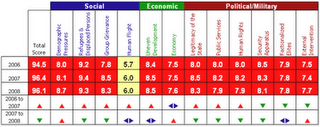
Uganda was last week ranked among the top 20 countries most vulnerable to state failure, according to the 2008 Failed States Index, produced by the Fund for Peace and Foreign Policy magazine. With a score of 96.1 out of a possible worst of 120, Uganda ties with Ethiopia for 16th most vulnerable, and fairs just marginally better than North Korea (97.7), Haiti (99.3) and Burma (100.3). Shocking? Not to Leader of the Opposition, Professor Ogenga Latigo. “I am not surprised,” he says, given the current political situation where rule of law is often non-existent and where the government is king. “Even police say they are acting from above, not according to the law,” says Latigo. The index comes to similar conclusions, ranking the military, judiciary, police and civil service as “weak,” and the quality of leadership as “moderate.”

Countries were scored based upon twelve social, economic, political and military indicators, and data was collected between May and December 2007 from over 30,000 open-source articles and reports. Uganda has barely improved since the 2007 Index, where it was ranked 15th most vulnerable. Does the Failed States Index do the country justice? Is Uganda in critical danger of becoming a failed state?

Of the twelve indicators, Uganda ranked the worst by far in the category of Refugees and Displaced Persons. Uganda is the third worst performing country worldwide in this category, only above Somalia and Sudan. According to the Uganda country profile compiled by the Fund for Peace, Uganda’s score is attributed to high numbers of refugees and people residing in internally displaced person’s (IDP) camps. The report states that Uganda hosts nearly 270,000 refugees from Sudan, Democratic Republic of Congo and Rwanda, and that there are nearly one million IDPs in Northern Uganda.

Uganda has been host to refugees from around the region for years as its neighbors have fallen into full fledged state collapse. This, however, would seem to indicate that the country is a safe haven for the region, not that Uganda is on the verge of state failure. Nevertheless, Nate Haken, an associate at Fund for Peace, explains: “If a country hosts a large number of displaced people, it puts pressure on the state because of the logistical challenges involved in feeding, housing education and protecting them. Additionally it puts a drag on the economy because when people are displaced, the community structures break down and people are unable to meaningfully participate in the workforce. All of this increases the potential for instability…”

State Minister for Relief and Disaster Preparedness and Refugees, Francis Musa Ecweru, does not believe this to be true in the case of Uganda, “The influx of refugees has done nothing to compromise our stability as a country,” he says. Although he adds, “It only puts pressure on law and order enforcement, because not all refugees are law abiding people.”

Roberta Russo, country representative for UNHCR, agrees with Ecweru. “I wouldn’t say it increases vulnerability,” she says, “but rather the opposite,” especially in light of the fact that sometimes Ugandans themselves benefit from the provision of services provided to refugees. She also says the situation with regard to refugees is improving. “First of all,” she says, “from Sudan we are repatriating a lot of refugees – over 60,000 since the beginning of the year, and many have returned spontaneously. In DRC the situation also seems to be improving since peace talks in Goma began.”

Moses Okello, head of research and advocacy at the Refugee Law Project, agrees that the ability of refugees to destabilize a country is an “overexageration,” particularly in Uganda. Rather, “What has been problematic,” he says, “is the government of Uganda using refugees for their own political purposes.”

The Fund’s Uganda country report rightly points out the fact that hundred of thousands of Ugandans are themselves displaced as a result of the over 20 year war between the government of Uganda and the Lords Resistance Army. But the miniscule improvement in Uganda’s score for this indicator since last year perhaps does not give enough credit to the very real progress that has been made in Northern Uganda. “The number of IDPs is decreasing extremely,” Russo says, “We now have less than 700,000 in camps.”

This is still an unacceptably large number of displaced people, but does it mean that Uganda deserves to be ranked third worst in the world? Okello says, “To a large extent I think that’s really fair…the government of Uganda for a long time managed to keep it [the conflict in Northern Uganda] under wraps…For a long time the international community did not know the scale of the conflict.” He argues that the government of Uganda was so concerned with perfecting their own image that they refused to call the conflict an emergency situation, which would have allowed international intervention at an earlier stage.

Despite the past mismanagement of the conflict, however, the government of Uganda is now well aware that there is much work to be done. Ecweru readily acknowledges the lack and inadequacy of public services in Northern Uganda, such as health facilities and basic infrastructure. Recovery of the north is next on his agenda. “We have to prepare them to recover…before they can graduate to development.” Perhaps with the recovery and resettlement of IDPs over the course of the next year, Uganda’s score will improve next year.

According to the 2008 index, Uganda has improved, albeit marginally, on a number of indicators since 2007 such as Group Grievance, Legitimacy of the State, Public Services, Human Rights and Security Apparatus. The indicators for which it has worsened are Demographic Pressures, Economy and External Intervention.

While demographic pressures are apparent in Uganda, with a population growth rate of around 3.6% — one of the highest in the world – it is less clear that the economy and external intervention have worsened in the past year. During his June 2008 Budget Speech, Minister of Finance, Dr. Ezra Suruma announced that real GDP growth in the fiscal year 2007/08 was estimated at a whopping 8.9%, much higher than the already commendable 6.5% that had been projected in the previous year’s speech. Though the Fund for Peace arguably did not have time to include this re-estimate in their calculation it was still clear during the research period that the Ugandan economy had been experiencing tremendous growth.

Nevertheless, the country report justifies its reasoning in assigning Uganda a worse score for its economy this year by stating: “…despite the country’s wealth in natural resources and a high GDP growth rate of 6.5%, political instability and mismanagement have left the economy undeveloped and poor.” To be certain, Uganda remains a developing country with a still nascent economy, but with a real GDP growth rate of 8.9%, it seems wildly unfair to even hint that the country is in “sharp and/or severe economic decline.”

In terms of the External Influence indicator, the Fund for Peace explains Uganda’s worsening score by stating, “The World Bank has 20 active projects in Uganda, with $1452 million committed in all sectors. In addition to foreign aid, Uganda has received considerable international attention due to the conflict with the LRA.” There is no doubt that Uganda receives a massive amount of foreign aid, but as a percentage of Uganda’s total budget, this figure has been decreasing. Whereas only a few years ago around half of Uganda’s budget was donor funded, according to this year’s budget speech, that figure is now closer to 30%. While Uganda still has a ways to go in making itself completely independent of donors, it may be unfair to say that the situation has gotten worse in the past year. Additionally, it is hard to see why Uganda should be penalized for the increased international attention the conflict in Northern Uganda has received and which very may well have assisted in finally bringing peace to Northern Uganda.

Ranked in the top 20 most vulnerable states, Uganda is in the “critical” zone for state failure. The Fund for Peace emphasizes, “It is important to note that these ratings do not necessarily predict when states may experience violence or collapse. Rather, they measure a vulnerability to collapse or conflict.” The Failed State Index is useful in that it looks at a broad range of factors that have the potential to induce or reduce the chance of conflict or societal deterioration. If the index can be used to accurately predict conflict, perhaps countries and regions can use it to prevent or mitigate violence, which, for example, could have saved hundreds of lives in Kenya, South Africa and Zimbabwe in this year alone.

Nevertheless, “failed state” is a loaded term. The fact that seven out of the ten worst performing countries are located in sub-Saharan Africa paints a bleak picture of a continent already heavily burdened with negative stereotypes. Organisations like Fund for Peace, “are totally out of touch with the realities here,” says Ecweru. This may be hyperbolic, but the point is clear. No matter their intentions, insinuating from an Ivory Tower that countries are “failed states,” and understating or failing to give due credit to countries who have impressive gains in development is unfair, misleading and dangerously discouraging.