2013: A year of reading

Happy belated 2013! I hope your year is off to a productive start. I rang in the new year with friends and family in Kampala, where I’ll be based for the next nine months or so, during which time I hope to become active again in this space. I’m currently conducting dissertation research on the history and politics of Muslim education of sub-Saharan Africa, among other collaborations with colleagues and friends here in Uganda. More on that to come.

In the meantime, and in my downtime, I have determined to make 2013 a year of reading. I think this is my one and only new year’s resolution; the gym has failed me time and again. For a long time I felt guilty spending time reading things that did not directly apply to my coursework or research, a terrible way to go through life (and grad school). You can find inspiration anywhere, and the joy of reading is something that is easy to forget when you have thousands of pages of required reading.

So, I’m posting below all the books I read this year for my own records and as encouragement (I’m very much a list person. Makes me more productive). I’m more than happy to hear your suggestions on books you love, whatever the topic. The Economist has a great list of best of 2012 books here.

Last update: December 30, 2013

Key:
* Don’t bother
** If you have some free time, I guess
*** Fun, interesting, and/or worthwhile
**** Outstanding or an important read
***** Read this book!!

Fiction:
The Historian, Elizabeth Kostova ***
The Round House, Louise Erdich ***
Island Beneath the Sea: A Novel, Isabel Allende ***
Sweet Tooth: A Novel, Ian Mcewan **
The Cutting Season: A Novel, Attica Locke ***
The Garden of Evening Mists, Tan Twan Eng ***
Ghana Must Go, Taiye Selasi ****
Americanah, Chimamanda Ngozi Adichie *****
And the Mountains Echoed, Khaled Hosseini *****
The Cuckoo’s Calling, Robert Galbraith (a.k.a. J.K. Rowling, yes I bought it right after I found out) ***
Beautiful Ruins: A Novel, Jess Walter ***
The Orphan Master’s Son: A Novel, Adam Johnson ***
We Need New Names: A Novel, NoViolent Bulawayo ****
The Lowland, Jhumpa Lahiri ****
Hard Times, Charles Dickens ***

Non-Fiction:
There Was  A Country: A Personal History of Biafra, Chinua Achebe ****
Spillover: Animal Infections and the Next Human Pandemic, David Quammen *****
Lean In: Women, Work and the Will to Lead, Sheryl Sandberg ****
Unorthodox: The Scandalous Rejection of My Hasidic Roots, Deborah Feldman ***
What I Wish I Knew When I Was 20: A Crash Course on Making Your Place in the World, Tina Seelig ****
The House at Sugar Beach: In Search of a Lost African Childhood, Helene Cooper ****
More Than Good Intentions: Improving the Ways the World’s Poor Borrow, Save, Farm, Learn, and Stay Healthy, Dean Karlan and Jacob Appel ***
Give and Take: A Revolutionary Approach to Success, Adam Grant ***
Predictably Irrational: The Hidden Forces that Shape Our Decisions, Dan Ariely ****
Triumph of the City, Edward Glaeser *****

Currently reading:
Sacred and Secular: Religion and Politics Worldwide, Pippa Norris and Ronald Inglehardt
One Day I Will Write About This Place: A Memoir, Binyavanga Wainaina
Why Nations Fail: The Origins of Power, Prosperity, and Poverty, Daron Acemoglu and James Robinson
The Shadow of the Sun, Ryszard Kapuscinski

K’naan, honestly

K’naan, a Somali-born musician known worldwide for his 2010 World Cup song, “Wavin’ Flag” (among others), wrote a brutally honest op-ed in last Sunday’s New York Times. It is rare to read someone who bares themselves so nakedly to the world — startling, searing, and awesome (a word I am afraid has lost its power with overuse). Most of us are too afraid to face the harshest critiques of ourselves, let alone announce them publicly.

SO I had not made my Marley or my Dylan, or even my K’naan; I had made an album in which a few genuine songs are all but drowned out by the loud siren of ambition. Fatima had become Mary, and Mohamed, Adam.

I now suspect that packaging me as an idolized star to the pop market in America cannot work; while one can dumb down his lyrics, what one cannot do without being found out is hide his historical baggage. His sense of self. His walk. I imagine the 15-year-old girls can understand that. If not intellectually, perhaps spiritually.

I come with all the baggage of Somalia — of my grandfather’s poetry, of pounding rhythms, of the war, of being an immigrant, of being an artist, of needing to explain a few things. Even in the friendliest of melodies, something in my voice stirs up a well of history — of dark history, of loss’s victory.

So I am not the easiest sell to Top 40 radio. What I am is a fox who wanted to walk like a prophet and now is trying to rediscover its own stride.

Uganda: The Health of the Nation

Published online Nov. 4, 2012 in The Independent.

The Health of the Nation
By Melina Platas Izama

Since Uganda hit 50 recently, it seems as good a time as any to check its vitals. There is the heartbeat of the economy and the temperature of the masses, the pressure of the politics and the weight of history. The health of this nation in one word? Resilient.

The Jubilee celebration was not made up of unfettered jubilation, as one might expect at 50 years of independence, but instead doused with a heavy coat of introspection.

The pristine Kampala Road, captured in black and white photos, is hardly recognisable today – a bustling, grating and downright stressful stretch of earth.  Cynics wandered and wondered aloud, are we better off now than we were a half-century ago? Teachers are striking, projects stalling, health clinics leaking staff, money, and drugs. This version of events is familiar. We listen to it every morning and read it every day. Frankly, it’s exhausting.

The health of the nation is in part a function of the health of its people. And here we have some great stories to tell. The greatest story of all is the about the survival of children. In the last fifteen years, death in infants and young children has fallen by nearly 40%. The drop in child deaths was faster in the past five years than it has been in decades.  This is fantastic news.

When Uganda raised her flag for the first time, mothers across the newly birthed state could expect more than one in five of their children to perish before age five and 13% of newborns would not survive their first year. This year, as the flag was raised once more, the death of a child is not foreign, as it should be, but neither does it go hand in hand with motherhood.

The results of the most recent round of the Demographic and Health Surveys (DHS), which have been instrumental in documenting these trends, have just been released for Uganda. Conducted across the country in more than ten thousand households, the DHS has been conducted in 1988, 1995, 2000, 2006 and 2011. While there are a number of improvements to report, the story of child survival, particularly in the last decade, stands out. It is perhaps the greatest achievement of the new millennium in Uganda. Continue reading “Uganda: The Health of the Nation”

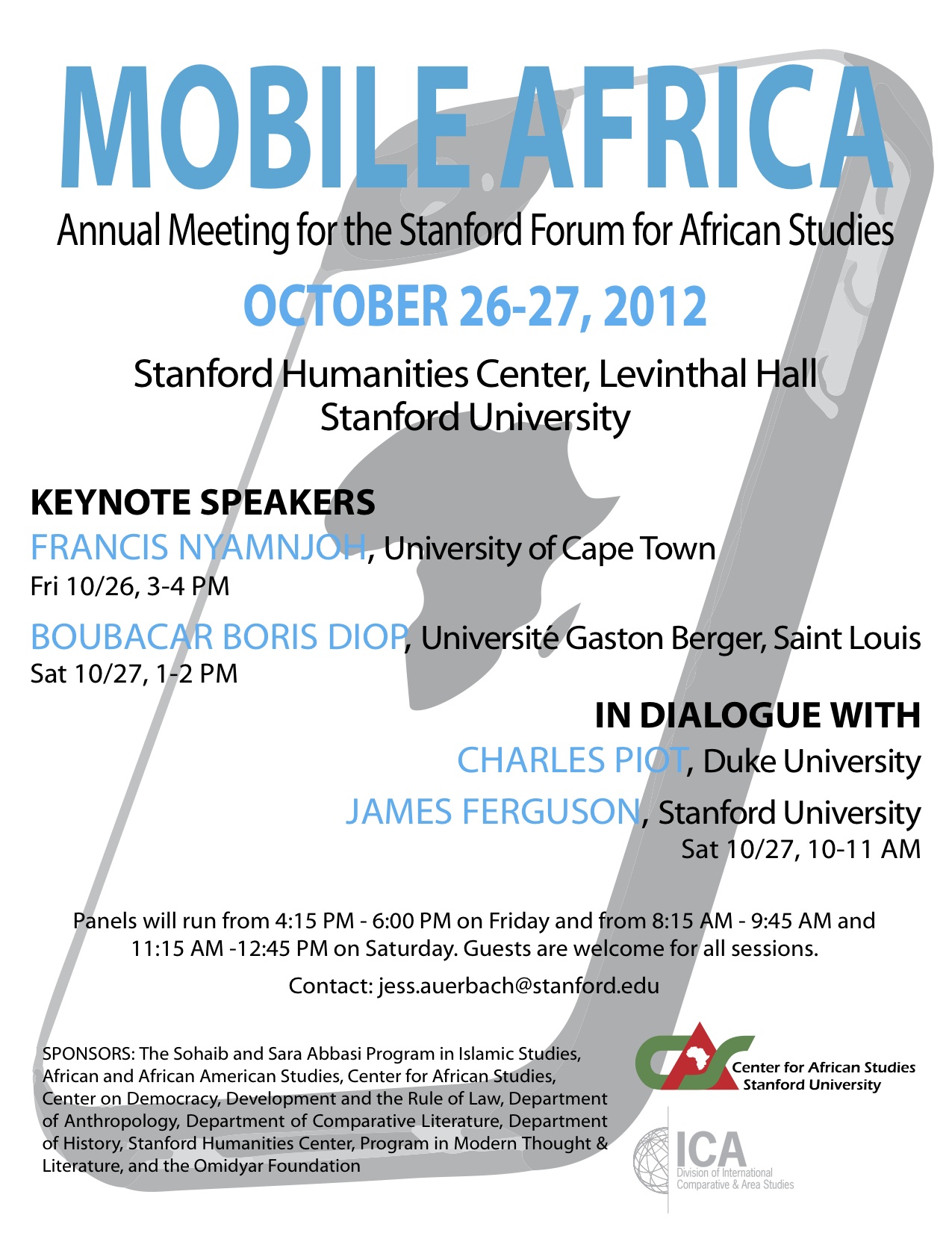
2012 SFAS conference, “Mobile Africa”

This year’s annual conference of the Stanford Forum for African Studies will be held October 26-27, 2012 at the Stanford Humanities Center. All are invited to attend. Guest speakers include Francis Nyamnjoh (University of Cape Town) and Senegalese writer Boubacar Boris Diop, best known for his book, Murambi.

The full conference program can be found on the SFAS website.

Ivory trade in the DRC

Jeffrey Gettleman of the NYT investigates a growing illicit trade in the DRC — not diamonds, gold, or minerals, but ivory. Evidence suggests that military forces in the area, including national armies from DRC, Uganda, and South Sudan, and rebel groups like the Lord’s Resistance Army, have been implicated in the illegal and deadly trade. As much as 70% of all ivory is headed to China. Excerpt below, full article here.

Some of Africa’s most notorious armed groups, including the Lord’s Resistance Army, the Shabab and Darfur’s janjaweed, are hunting down elephants and using the tusks to buy weapons and sustain their mayhem. Organized crime syndicates are linking up with them to move the ivory around the world, exploiting turbulent states, porous borders and corrupt officials from sub-Saharan Africa to China, law enforcement officials say.

But it is not just outlaws cashing in. Members of some of the African armies that the American government trains and supports with millions of taxpayer dollars — like the Ugandan military, the Congolese Army and newly independent South Sudan’s military — have been implicated in poaching elephants and dealing in ivory.

Video: The Ivory Wars

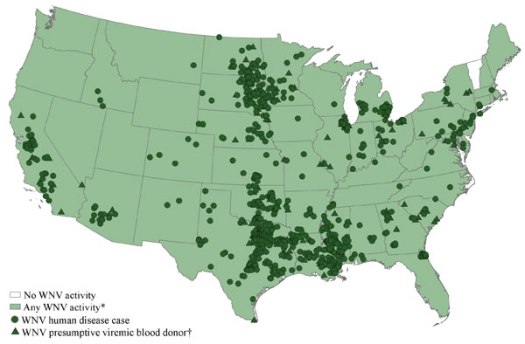
What’s up with West Nile?

West Nile virus, that is. A widespread outbreak in the U.S. has attracted renewed attention to the virus, which acquired its name from West Nile, Uganda, although there is no evidence that it originated there. Unfair, isn’t it? The virus was first isolated in Omogo, West Nile district, Uganda, in 1937, by researchers at the Yellow Fever Research Institute, then based in Entebbe. According to a 1940 article by Smithburn et al. in the American Journal of Tropical Medicine and Hygiene:

In attempting to isolate virus numerous persons were seen who were suffering either from an illness suggesting yellow fever, or from pyrexia of unknown cause. From many such persons blood was drawn, and as soon as possible thereafter the serum was in oculated intracerebrally2 into mice. Subinoculations were done from mice which became ill. In this manner several transmissible infective agents were isolated.

The purpose of this paper is to report the isolation of one such agent, which we call the West Nile virus, and to describe some of its properties. Although this virus was isolated from the blood of a human being, the circumstances of its isolation were such that nothing is known regarding the illness produced by the virus in the human subject.

That the virus was identified in West Nile should, if anything, be a testament to the medical contributions that have been made from the region, but it is more likely to have inspired notoriety. West Nile virus outbreaks have occurred all over the world, but the virus was not identified in North America until 1999.

West Nile virus is carried by mosquitoes, which acquire the virus from infected birds. In rare cases (only about 1 in 150 cases), severe viral infection is characterized by “high fever, headache, neck stiffness, stupor, disorientation, coma, tremors, convulsions, muscle weakness, vision loss, numbness and paralysis“, according to the CDC. Up to 80% of those infected, however, do not experience any symptoms.

Current map of West Nile activity in the U.S.:

CDC surveillance of West Nile virus in the U.S., activity as of August 21, 2012

Home at last in Mogadishu

In the Somalia of today, comedians are murdered for telling jokes and journalist butchered for telling the truth. Certainly this cannot be the time for developing a constitution. I cannot but conclude that the constitutional process is nothing more than an attempt by the international community to make legitimate their engagement and support to a government they have conceived and created.  Somalia’s new elite has found in the current arrangement an environment conducive for their emergence and growth – and it is here that a marriage between the uninformed and the ambitious begins and the constitution becomes their marriage certificate.
I left Mogadishu feeling both hopeful and sad. Hopeful because of the colorful exhibition of humanity to survive extremes, dust itself off and launch a comeback. I was hopeful because in AMISOM, we see Africans attempting to solve their problems. Saddened, because I fear forces of primitive association are gaining strength. As for my own personal journey, I left feeling Somali and certainly more African than ever before. This journey laid some of my personal ghosts to rest. Yes, I am Somali and yes I am African with a billion fellow travellers.

That is Mo Yaxye in The Independent, “Coming home to Mogadishu“.

Dying to be President

Meles Zenawi of Ethiopia is only the most recent of a series of African leaders to die while in office. Prof. John Atta-Mills of Ghana passed away in July, and Malawi’s Bingu wa Mutharika before that. Rumors continually swirl about the health of other current presidents, including Zimbabwe’s octogenarian, Robert Mugabe. The health of leaders is often veiled in secrecy, which can make it difficult to plan for potential transitions.

In the days immediately following the death of Atta-Mills, many of those I spoke to in Ghana were sad, but also a little angry. How could he dance and jog on his return from a medical check-up in the US when he knew he was so sick? Former president Jerry Rawlings gave a frank, if rather callous, assessment on the BBC: “I think had he been advised and done something wiser, you know, earlier on, he could have probably survived, you know, for, I don’t know, for another six-seven months…” There was a feeling expressed by some people I spoke to that Prof. Atta-Mills should have taken time off, and taken care of himself. This calls to a more general problem — the secrecy enshrouds the health of leaders sets up governments for moments of crisis. Fortunately, Ghana and Malawi have both managed to pull through with successful transitions, but others may not be so lucky.

Songwe and Kimenyi examine this issue in their op-ed, “The Health of African Leaders: A Call for More Transparency” at Brookings:

As the number of ailing presidents increases, three major issues are emerging: First, the continent demands more transparency regarding it’s leaders’ health; second, democracies need clear term limits; and third, successful democratic transitions require transition processes outlined in the constitution, that are understood and familiar to all. With these safeguards in place, the risks of administrative paralysis, political tension, internal conflict and instability that characterize situations in many African countries could be mitigated. Unfortunately, in many African countries today there is a general lack of clarity around term limits and even less clarity and agreement on succession: Term limits are changed on a rolling basis, and constitutions are amended frequently.

Ghana through a lens

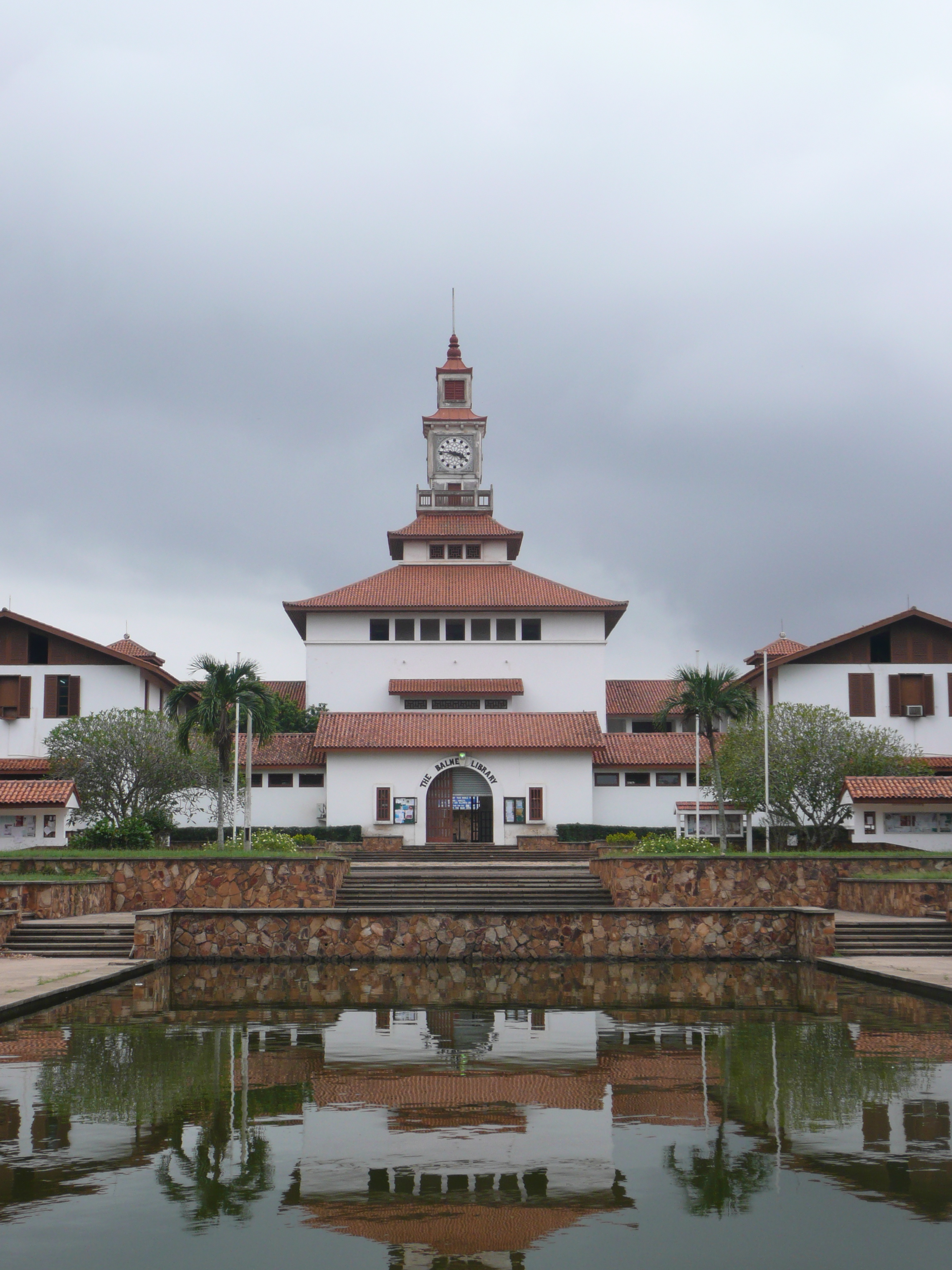
I recently returned to Kampala from three weeks in Ghana — Accra, Tamale, Upper East and Upper West. My visit coincided with the untimely passing of Ghana’s president, John Atta-Mills, the swearing in of new president John Dramani Mahama (who, coincidentally, just published his book, My First Coup d’Etat), and the three day funeral that followed. Below are some shots from around the country:

University of Ghana, Legon
Basilica of St. Theresa, Nandom, Upper West
Tamale, Ghana
A city in mourning, Accra, Ghana