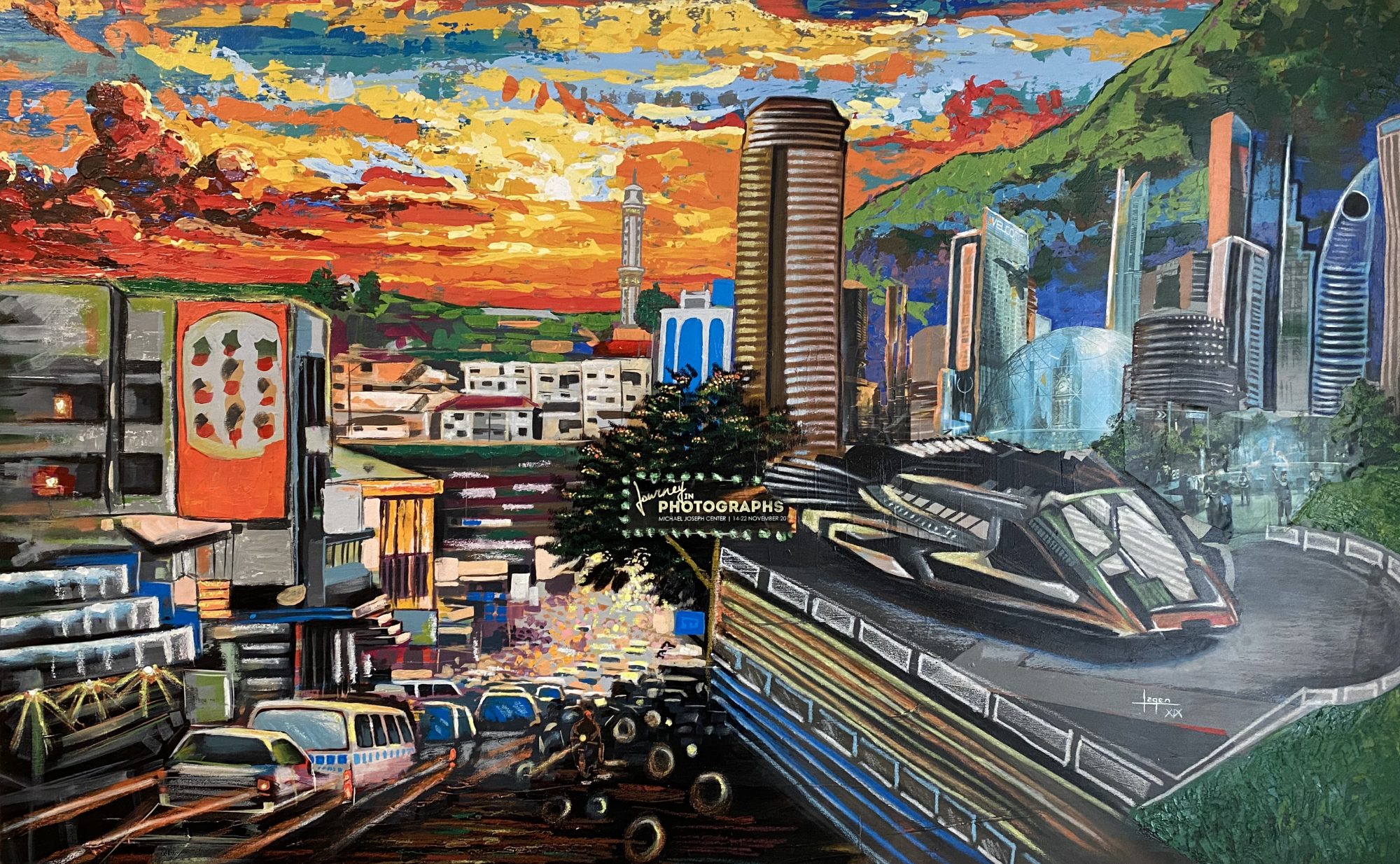
 Voters queue outside Luzira, Kampala

Polling station in Kampala

Voters queue outside Luzira, Kampala
Polling station in Kampala
for the best updates on election results is clearly the Daily Monitor. Their coverage on their website, on Facebook, on Twitter, is superb.

Above: Incumbent MP and minister of defense Amama Mbabazi in Kunungu District, Western Uganda

Above: Campaign Posters in Masaka Town, Central Uganda
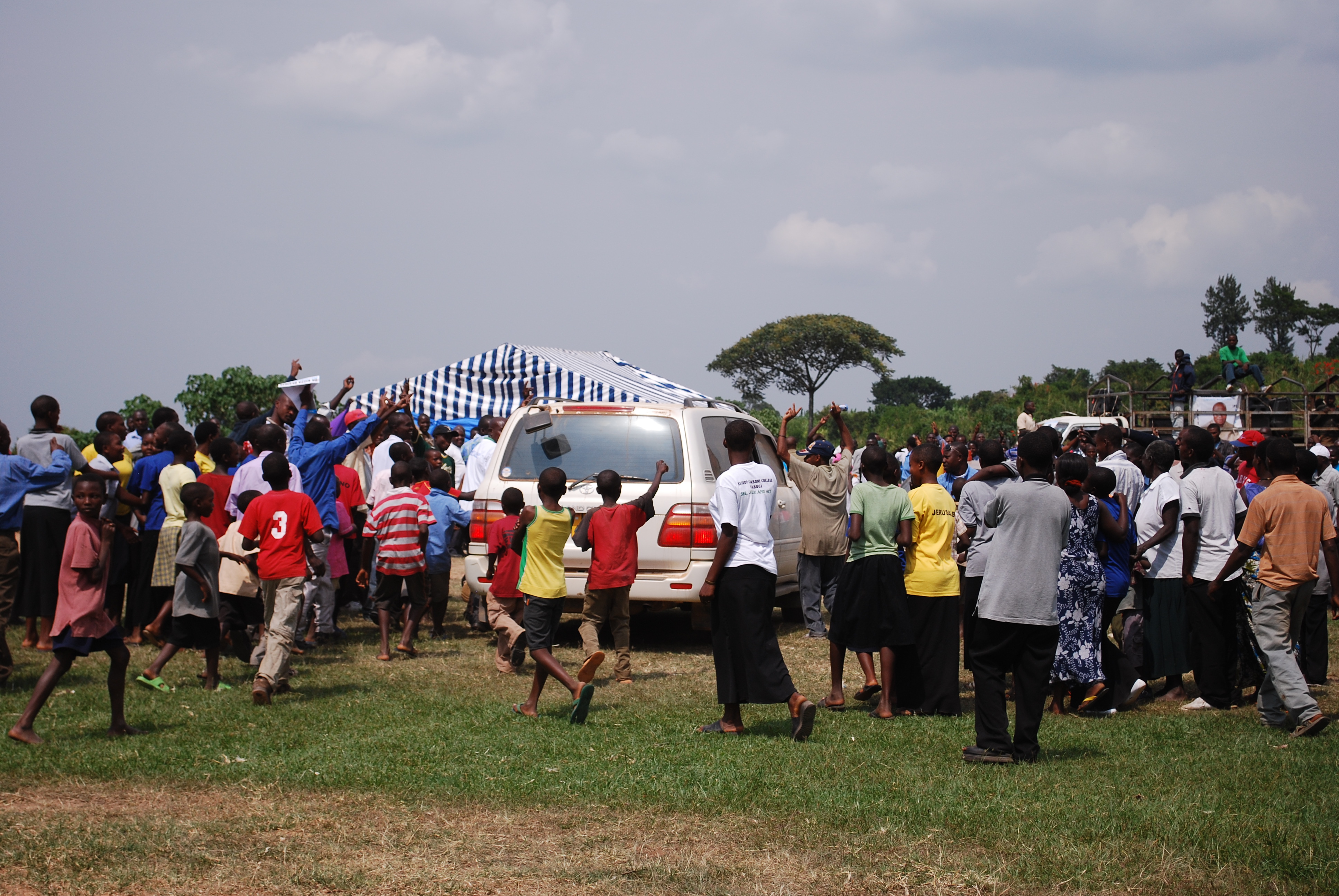
Above: Besigye arrives in Kanungu

Above: Besigye addresses his supporters in Kanungu

Above: Museveni’s rally in Lwengo, Central Uganda on February 10, 2011
It is the final day before Uganda’s 2011 national presidential and parliamentary elections. Yesterday, amidst the final rallies of the presidential candidates, Kampala remained eerily calm. It is as if people are preparing for a natural disaster, a hurricane. Some have packed up and left town, others have stocked up on water and foodstuffs. Most people in town are hoping for just one thing, a peaceful election. The memory of the 2007 Kenyan election is still fresh, and the revolutionary spirit across North Africa and the Middle East is enough to make you second guess your perceptions of
The Independent has just put the election issue online. Our cover story is up here, and you can read Andrew’s final pre-election analysis here. He concludes:
It is now clear to me that what Uganda needs to change is not just a political party fighting for power in Kampala. Our country needs a social movement whose organisation begins from the village. This movement has to avoid the false dichotomy of NRM versus FDC or UPC. It has to embrace Ugandans of all creed against the ills that bedevil our public sector. We need to reconstruct our politics from private greed to public service. That is our challenge.
In this video for the Independent, Andrew began interviewing taxi drivers and conductors in the Mbarara taxi park. After a short time the owner of the park told us to pack up and go elsewhere. We were later told that one of the men we interviewed was fired for talking to us. As in Masaka, there were many young men who expressed discontent with Museveni and announced they would support Besigye.
Here, with just one week to the 2011 national elections in Uganda, Andrew Mwenda interviews residents of Kitagata, in Sheema district, formerly part of Bushenyi district, and finds surprising levels of support for Kizza Besigye.
I traveled through central and western Uganda with Andrew Mwenda last week/weekend. Some video I took from the trip is posted on the Independent website under the video tab (right side of the page) but I will also be embedding them here. The first, below, is Andrew’s analysis after attending Museveni’s rally in Masaka.
I’m in Masaka today, a small town 2 hours southwest of Kampala, following President Museveni’s campaign. This is a small and quiet town, but from the hotel in town I can hear a lot of hooting and shouting — it’s possible Museveni’s convoy has just arrived. He has won this central region district in past elections, winning about 64% of the vote in 2001 and 59% in 2006. The urban areas, namely Masaka Municipality, tend to vote for Kizza Besigye, the main opposition candidate for the past three elections. But the rural areas are pro-Museveni.
In all likelihood Museveni will win again here, and win big.
More soon….
DHS Malaria Indicator Survey for Uganda is now available.
Hat tip William Brieger
Is HIV/AIDS funding distorting health priorities in ways that actually harm efforts to improve public health? If so, how? These are questions I have wondered about for a long time. In 2008, the U.S. government spent $283 million dollars in Uganda on the HIV/AIDS sector via the President’s Emergency Plan for AIDS Relief (PEPFAR). In the same year, the Ugandan government spent approximately $180 million on the entire health sector. What impact does PEPFAR levels of donor funding for HIV/AIDS have on the recipient country’s health priorities? On the amount of money spent on other health issues? On the number of doctors that work in primary care?
Tapiwa Gomo of Newsday writes:
” … The UNAIDS projects that by 2015, the annual resource needs will reach $54-57 billion (a total of approximately $172 billion in three years) which could avert 2,6 million new infections and 1,3 million deaths. Still this is not enough to cater for the 33 million people living with the virus today.
As a result of the presence of such huge financial figures, the HIV and Aids industry has uncontrollably grown in size and budget, thanks to the generous donors who can finance anything or anyone as long as there is an HIV and Aids dimension in the proposals.
However, what concerns some experts is that the impact of this colossal and resource-guzzling industry is not parallelled by results on the ground, in addition to the damage it has caused on the public health sector especially in Third World countries...”
The article in full can be found here.
I only have speculative and anecdotal evidence pointing to negative side effects of gargantuan HIV funding, but I am currently working on a project that I hope will provide more quantitatively sound evidence. More on this as the project comes along.
 Melina Raquel Platas